- Why BSCI Matters Particularly in the Bag Manufacturing Industry
- Ⅰ. BSCI Audit Scope for Bag Factories: 13 Performance Areas and Four Buyer-Risk Categories
- Ⅱ. BSCI Ratings from A to E: The Key Difference Is the Follow-Up Cycle
- Ⅲ. Changes to Audit Notifications: Last-Minute Preparation Is Less Effective
- Ⅳ. Buyer Verification Checklist: What to Check in a BSCI Report
- Ⅴ. What BSCI Does Not Replace
- Ⅵ. Frequently Asked Questions (FAQ)
- Ⅶ. Conclusion
The amfori Business Social Compliance Initiative (BSCI) is a social compliance auditing system operated by amfori. It evaluates factory labor conditions, working-hour and wage management, occupational health and safety, environmental management, and business ethics. It is important to understand that BSCI is not a product quality inspection. It does not assess bag workmanship, fabric performance, or hardware quality; these are covered by separate quality-control and testing processes.
Why BSCI Matters Particularly in the Bag Manufacturing Industry
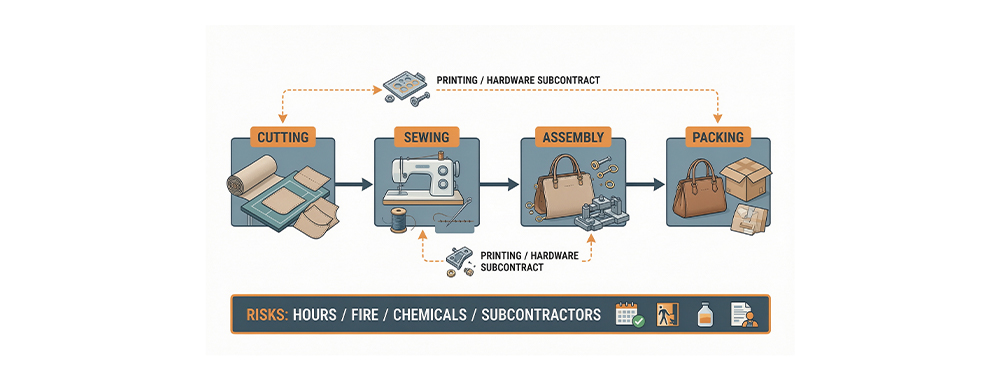
The importance of BSCI in the bag industry is closely linked to the way bags are manufactured. Cutting, sewing, assembly, and packing are labor-intensive processes, and overtime tends to peak during busy seasons. PU materials, adhesives, and solvents require chemical management, while printing and hardware-related processes are often outsourced. These characteristics shape the main social-compliance risks for bag factories: consistency of working-hour records, clear fire exits and evacuation routes, proper chemical storage, and control of subcontractors.
European brands use BSCI audits to identify and manage these risks. For many bag manufacturers, a credible audit record is also one of the prerequisites for joining a European customer’s approved supplier network. This article explains the audit scope, rating system, notification methods, and key points buyers should verify.
Ⅰ. BSCI Audit Scope for Bag Factories: 13 Performance Areas and Four Buyer-Risk Categories
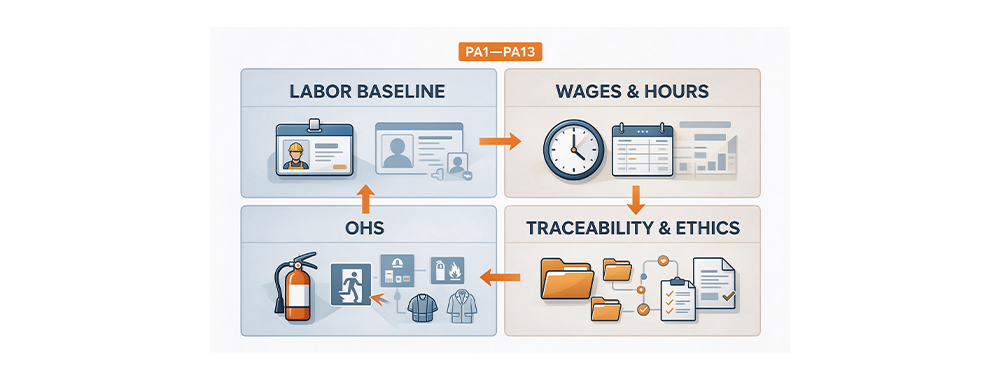
The current amfori BSCI framework covers 13 Performance Areas (PAs), which can be grouped into four categories: social management and workplace relations (PA1–PA4); worker well-being and fair practices (PA5–PA7); protection of vulnerable workers (PA8–PA11); and environmental protection and business ethics (PA12–PA13). The following section summarizes them into four categories that map directly to supplier risks, helping buyers make rapid judgments.
1. Fundamental Labor Standards
- This category covers the prohibition of child labor (PA8), secure employment (PA10), and the prohibition of bonded labor, forced labor, and human trafficking (PA11). On-site checks at bag factories typically include verifying that workers’ ages are properly documented, checking that identity documents are not withheld, confirming that workers are free to resign, and ensuring that temporary and outsourced workers are managed under consistent standards.
- Young workers are subject to specific protections under PA9. They must not be assigned to high-risk positions such as cutting or chemical handling, and restrictions on working hours and night shifts must be observed.
2. Wages and Working Hours
- This category corresponds to Fair Remuneration (PA5) and Decent Working Hours (PA6). Wages must meet or exceed the local minimum wage, and overtime must be paid at the legally required rates. BSCI also sets requirements for weekly rest days, limits on working hours, and overtime management.
- During peak production periods, auditors cross-check attendance records against payroll data and daily production reports. For example, if production records show output every day during the month’s busiest period while attendance records show consecutive rest days, the records may be considered unreliable even if the total hours on an individual time card appear compliant.

3. Occupational Health and Safety
- This corresponds to PA7 and is an area where bag factories may receive substantive non-compliances. Auditors inspect whether fire routes and emergency exits are unobstructed, whether fire extinguishers are within their service dates and free from obstruction, and whether each floor has independent safe exits. They do not rely solely on the floor plan.
- Common sources of non-compliance include inadequate machine guards at cutting and bonding stations, a lack of secondary containment for chemical containers, and Safety Data Sheets (SDS/MSDS) that are available only in the office rather than on the shop floor.

4. Management Systems, Traceability, Environment, and Business Ethics
- This category covers Social Management Systems and Cascade Effect (PA1), Workers’ Involvement and Protection (PA2), Freedom of Association and Collective Bargaining (PA3), No Discrimination, Violence, or Harassment (PA4), Environmental Protection (PA12), and Business Ethics (PA13).
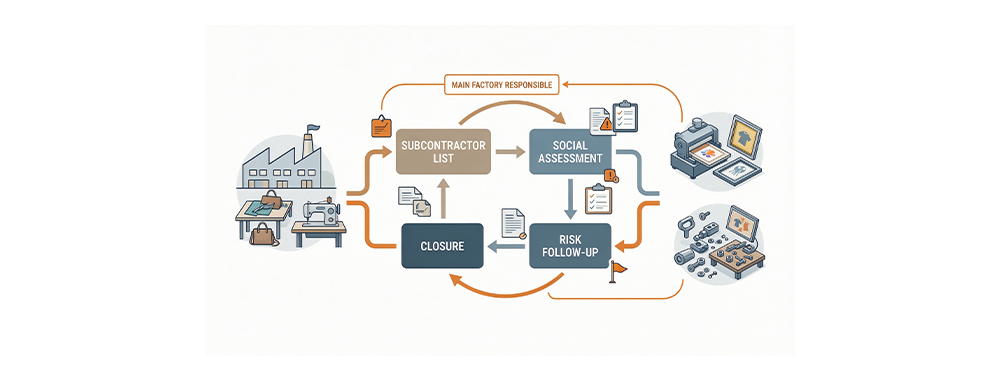
- For bag factories, subcontractor control is a particularly important audit focus. If printing or hardware processes are outsourced, the main factory should maintain a subcontractor list, social-compliance assessment records, and documented follow-up actions. If a factory declares that it does not outsource any processes but auditors find outsourcing documents on site, this may result in a serious non-compliance. The main factory remains responsible for serious compliance issues at subcontracted facilities.
Zero-Tolerance Issues
The zero-tolerance mechanism requires special attention. Severe issues such as child labor, forced labor, locked emergency exits, completely blocked evacuation routes that pose an immediate threat to life, physical assault, and sexual harassment do not follow the ordinary rating process. The audit may be suspended, the factory must take immediate corrective action, and a re-audit must be conducted within the specified period. Zero-tolerance issues cannot be closed simply by submitting a Corrective Action Plan (CAP). Buyers will generally suspend orders while such issues remain unresolved.
For buyers, checking whether a supplier has any historical zero-tolerance findings should take priority over reviewing ordinary non-compliances.
Ⅱ. BSCI Ratings from A to E: The Key Difference Is the Follow-Up Cycle
After the audit, the factory receives an overall rating from A to E. For procurement teams, the most important implication is not simply whether the result is “good” or “bad,” but when the next audit will take place.
1. Validity Periods and Follow-Up Audits
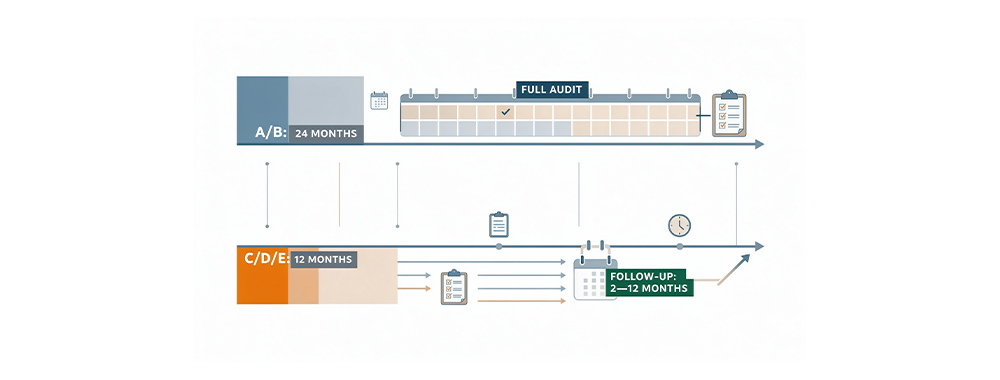
- A and B ratings are valid for 24 months. A follow-up audit is not normally required during this period, and the next full audit is scheduled when the validity period expires. However, an A or B rating does not exempt a factory from all further checks: amfori may conduct random unannounced checks during the 24-month period, and serious non-compliance may lead to early termination of the report’s validity.
- C, D, and E ratings are valid for 12 months after the full audit. A follow-up audit may also be required between 2 and 12 months after the full audit. The lower the rating, the more frequent the follow-up and the more cautiously buyers may handle orders. Passing a follow-up audit does not reset the validity period; the original full-audit date remains the basis for calculating validity.
2. What Buyers Should Consider When Interpreting Ratings
- A C rating is a common minimum threshold for many European buyers, but it is not accepted by all of them. Some retailers require a B rating or higher under their internal procurement policies. Confirm the buyer’s minimum acceptable rating before starting cooperation rather than assuming that C is sufficient.
- An overall C rating is not necessarily equivalent to a low rating in a critical individual area. If the overall result is mainly affected by management-system documentation or environmental issues, while working hours, remuneration, and fire safety perform reasonably well, the risk profile differs from one involving major fire-safety or chemical-management non-compliances. Review the individual ratings for Working Hours, Remuneration, and Occupational Health and Safety, not just the overall grade.
- Full amfori BSCI audits are scheduled on a two-year cycle. Factories cannot simply apply for another full audit every year. If the result is C, D, or E, the next step is generally a follow-up audit rather than a new full audit.
Ⅲ. Changes to Audit Notifications: Last-Minute Preparation Is Less Effective
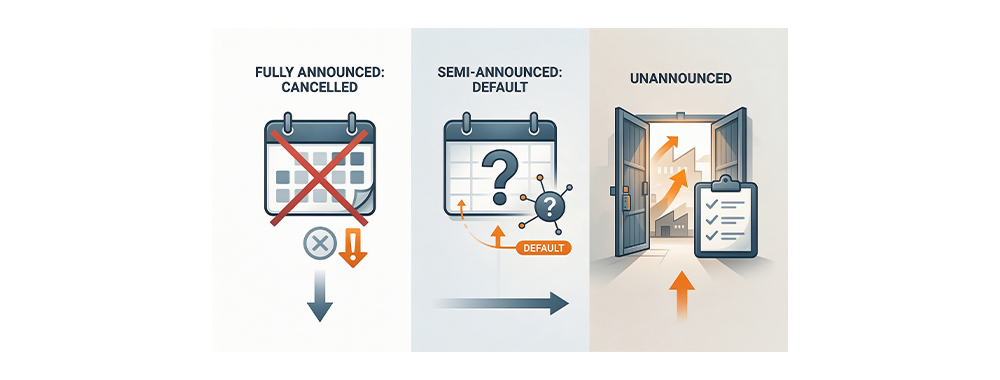
Since September 1, 2024, amfori has no longer accepted fully announced BSCI audit applications. Two notification methods remain: fully unannounced and semi-announced. Semi-announced is the default option when an audit is requested through the amfori platform.
For bag factories, this means there is far less room to add attendance records or organize the production floor only after receiving an audit notice. A semi-announced audit provides a visit window, but the exact arrival time within that window is not predictable. In a fully unannounced audit, the factory’s normal operating conditions on the day of the visit are assessed directly.
If a factory can present compliant conditions only after learning the audit date, buyers should carefully assess whether its BSCI report reflects stable compliance under normal production conditions.
Ⅳ. Buyer Verification Checklist: What to Check in a BSCI Report
After the audit, the report is uploaded to the amfori Sustainability Platform. Buyers who are amfori members can search for and link a business partner using the factory’s DBID or name, then access the original audit report and corrective-action status. A copy supplied by the factory can serve as a reference during routine communication.
The following seven checks can be used directly by procurement teams:
1. Audit Type
Confirm that the report is for Full Monitoring rather than a follow-up audit or an audit with incomplete scope. A follow-up audit focuses only on areas requiring new evidence from the previous audit and is not equivalent to a full audit.
2. Notification Method
Check whether the audit was semi-announced or fully unannounced. Results from a fully unannounced audit are generally harder to achieve through last-minute preparation.
3. Rating Distribution
In addition to the overall grade, review the individual ratings for Working Hours, Remuneration, and Occupational Health and Safety. These areas are closely connected to the factory’s day-to-day operations.
4. Validity Period and Audit Date
Check whether an A/B report falls within 24 months and a C/D/E report within 12 months. Confirm that the production address covered by the audit is the current supply address. A report for an old address does not automatically cover a new site after relocation or expansion.
5. Subcontractor Coverage
If printing or hardware processes are outsourced, check whether the report addresses subcontractor management or whether the factory can provide a subcontractor list and social-compliance assessment records.
6. Zero-Tolerance History
Check the supplier’s historical audit records for zero-tolerance issues. If any are recorded, confirm that corrective actions have been completed and that the results of the re-audit are available.
7. Corrective-Action Status
For C ratings and below, check whether a Corrective Action Plan (CAP) is being implemented. Ask the factory to explain the closure status of key non-compliances and the expected completion dates.
The key point is that buyers need more than a “BSCI” label. They need a report that is valid, covers the actual production site, contains complete information, and reflects the factory’s normal operating conditions.
Ⅴ. What BSCI Does Not Replace
Understanding the limits of BSCI helps buyers avoid gaps in supplier qualification.
1. Product Quality Inspection
BSCI does not assess bag workmanship, the physical performance of fabrics, or hardware durability. These require separate product inspections and laboratory tests.
2. Raw-Material Compliance Requirements Such as EUDR
BSCI focuses on labor and human rights, while the EU Deforestation Regulation (EUDR) addresses whether relevant commodities and products are associated with deforestation risks. They are parallel compliance tools, and many European buyers may require both. A BSCI audit report is not proof of EUDR compliance.
3. A Permanent Pass
Ratings determine the follow-up cycle, and reports have limited validity. Changes to the production address or subcontracting structure may also make an old report inconsistent with the actual supply chain.
4. The Buyer’s Own Commercial Assessment
A C-rated report may be acceptable within the risk tolerance of a particular buyer or product category. Buyers should still assess the supplier’s capacity, quality history, and order structure as a whole.
Ⅵ. Frequently Asked Questions (FAQ)
Q1. Is BSCI a certificate?
A: No. BSCI is not a certification or qualification scheme; it is a social-compliance audit. After the audit, a report is generated on the amfori Sustainability Platform. The report has a defined validity period, and amfori-member buyers can retrieve the original records using the factory’s DBID.
Q2. Does a BSCI audit inspect the quality of bags?
A: No. BSCI does not evaluate product quality, workmanship, fabric performance, or hardware durability. These are handled through separate inspection and testing processes. BSCI focuses on labor conditions, wages and working hours, occupational health and safety, the environment, and business ethics.
Q3. What BSCI rating do bag factories need to meet European buyers’ requirements?
A: A C rating is a common threshold for many European buyers, but not all buyers accept it. Some retailers require B or higher. D and E ratings may lead to suspended orders or requirements for corrective action. The practical recommendation is not to assume that C is sufficient; confirm the buyer’s internal policy before cooperation.
Q4. How long is a BSCI audit report valid?
A: Reports with A or B ratings are valid for 24 months. Reports with C, D, or E ratings are valid for 12 months and may require a follow-up audit 2–12 months after the full audit. Lower ratings generally mean closer follow-up and stricter buyer scrutiny.
Q5. Must a BSCI audit at a bag factory cover subcontractors?
A: Where processes such as printing or hardware surface treatment are outsourced, the main factory should maintain a subcontractor list, social-compliance assessments, and follow-up records. Auditors may trace relevant subcontractor documentation, and serious compliance issues at a subcontractor can affect the main factory’s rating.
Q6. Who pays for a BSCI audit?
A: The factory generally pays for a semi-announced audit, although the parties may agree otherwise through commercial negotiation. From October 1, 2025, fully unannounced audits are restricted to amfori members holding RSP (Audit Management Rights), and the buyer initiating the audit must pay. The factory or a third-party intermediary may not pay on the buyer’s behalf; otherwise, the audit will be deemed invalid on the amfori platform. Fees vary by audit body, factory size, and location, and amfori does not set a single standard price.
Q7. What is the difference between BSCI and SEDEX/SMETA?
A: Both are social-compliance audit frameworks, but they operate through different membership platforms, and their reports are not interchangeable. BSCI is operated through amfori and is widely used by European retail brands. SEDEX/SMETA is more commonly used by buyers in the UK and North America. A report under one framework does not automatically satisfy a buyer’s requirements under the other.
Q8. Does BSCI compliance mean EUDR compliance?
A: No. BSCI focuses on labor and human rights, while EUDR addresses deforestation-related risks in raw materials. They are separate supply-chain due-diligence tools. A valid BSCI report cannot replace proof of EUDR compliance, and vice versa.
Q9. What does zero tolerance mean in a BSCI audit?
A: Zero tolerance applies to extremely serious violations, including child labor, forced labor, locked emergency exits, major safety hazards such as completely blocked evacuation routes that pose an immediate threat to life, physical violence, and sexual harassment. Once triggered, the audit is suspended. The factory must take immediate corrective action and undergo a re-audit within the specified period, and buyers will generally suspend orders in the meantime. Such cases cannot be closed through the normal CAP follow-up process. When reviewing a supplier’s history, buyers should first confirm whether any zero-tolerance findings exist and whether they were properly resolved.
Ⅶ. Conclusion
BSCI audits are a routine part of supply-chain social-compliance due diligence for many brands and an important reference when buyers qualify bag manufacturing partners. Our company holds a valid amfori BSCI audit report. For customers whose supplier-approval requirements include BSCI, we can provide the report rating, DBID, and a copy of the report to support supplier qualification. Please contact us to request the relevant information.