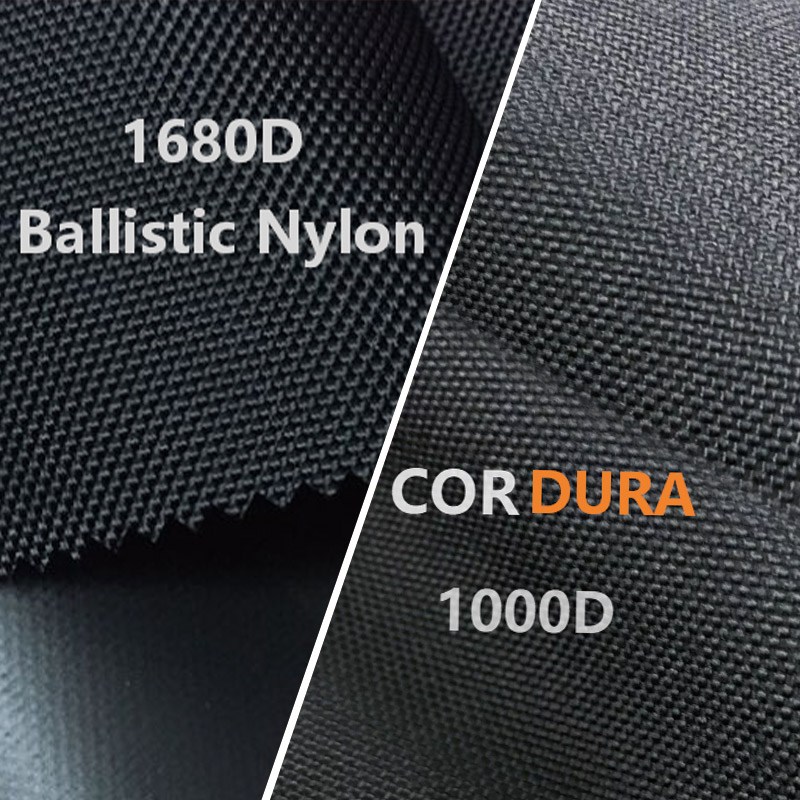
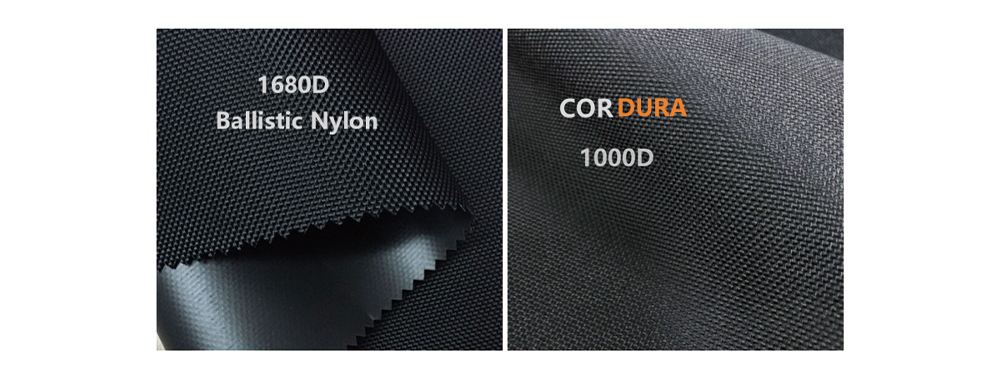
“Ballistic nylon” refers to a weave — a high-density nylon fabric woven in a 2×2 basket weave, most commonly seen in 840D and 1680D. CORDURA®, on the other hand, is a fabric brand owned by INVISTA, built around a family of fabrics woven from high-tenacity nylon 6.6 filament, most commonly in 500D and 1000D. The two specifications most frequently used in premium backpacks are 1680D ballistic nylon and 1000D CORDURA® nylon, which is why they are so often compared side by side. Here is how they differ in terms of durability:
- Surface abrasion resistance: the ability to withstand long-term scuffing, dragging and rubbing on concrete floors, airport conveyor belts and gravel roads — in this regard, 1000D CORDURA® nylon is more durable. Its nylon 6.6 air-textured yarns and tight plain weave consistently outperform basket-woven ballistic nylon in standardized abrasion testing, and its matte, slightly textured surface hides dirt and scuffs better.
- Tear and puncture resistance: here 1680D ballistic nylon has the edge. Its thick yarns and 2×2 basket weave distribute point loads more effectively, making tears less likely to propagate — a performance level with almost no rival among fabrics in its price range.
1. Does Denier (D) Determine Durability?
Denier (abbreviated “D”) is a unit of linear mass density for yarn: 1 denier means that a 9,000-meter length of yarn weighs 1 gram. A 1000D yarn therefore weighs 1 kilogram per 9,000 kilometers of length. The denier number is only one of the factors that influence durability — it cannot determine durability on its own. Each of the following variables matters as much as, and often more than, the denier number itself:
- How tightly the fabric is woven (ends and picks per inch);
- What polymer the yarn is made from (nylon 6, nylon 6.6, or polyester);
- Whether the yarn is flat filament or air-textured;
- What weave structure is used (plain, twill, or basket);
- And what coatings and finishing treatments have been applied.
This is exactly why 1000D CORDURA® nylon outperforms 1680D ballistic nylon in surface abrasion resistance.

2. The Pros and Cons of 1680D Ballistic Nylon
2.1 What Is 1680D Ballistic Nylon?
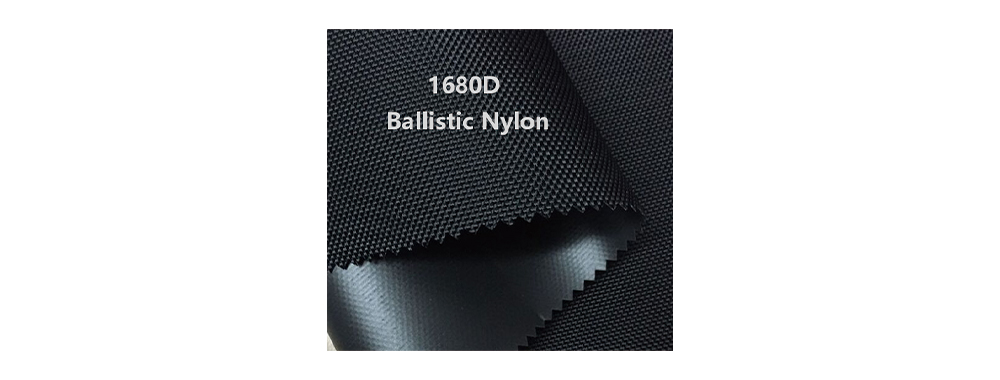
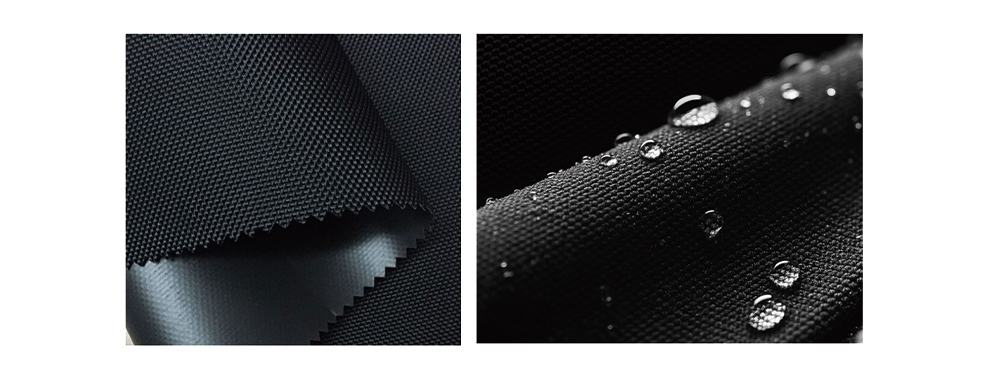
“Ballistic” describes a weave. The original fabric was a 1050D-class nylon in a 2×2 basket weave: two warp yarns interlaced with two weft yarns as a unit, creating the signature checkerboard surface. Modern 1680D ballistic nylon is the heavyweight commercial descendant of that cloth, most commonly woven from plied 840D-class yarns in the same 2×2 basket weave, then finished with a polyurethane (PU) coating on the back and a durable water repellent (DWR) treatment on the face.
Unlike CORDURA, ballistic nylon is a generic construction name, not a registered trademark. Any mill can weave it — which is a commercial advantage, and one reason it is so widely used on premium business backpacks.
2.2 What Are the Advantages of 1680D Ballistic Nylon?
2.2.1 Functional: tear resistance is ballistic nylon’s signature strength
The 2×2 basket weave bundles yarns together; when a sharp object tries to puncture or tear the fabric, these yarn bundles can shift and share the load. Combined with the sheer bulk of the plied yarns, 1680D ballistic nylon performs excellently in tongue-tear and Elmendorf-type tear tests.
2.2.2 Appearance
The long floats of the basket weave give ballistic nylon a silky, lustrous surface — a deep, slightly glossy technical look. Ever since brands like Tumi built their entire brand DNA on this fabric, consumers have associated this sheen with “premium business luggage.”
2.2.3 Supply chain
Thanks to its generic construction and zero trademark barriers, 1680D ballistic nylon is woven by mills everywhere, giving buyers more supplier options, greater negotiating leverage, and easier lead-time compression. For premium backpack brands, this means no lock-in to a single authorized channel, faster response when changing specifications, colors or fabric weight, and lower MOQ thresholds.
CORDURA®, by contrast, is a branded fabric with a more complete consistency and traceability system, but purchasing must go through authorized supply chains, with pricing and lead times more subject to the brand owner’s schedule. So the trade-off here is not about durability itself, but about whether a brand values supply flexibility or quality endorsement more.
2.3 What Are the Disadvantages of 1680D Ballistic Nylon?
The basket weave has fewer interlacing points than a plain weave, meaning individual yarns shift more easily, and the long floats on the face expose more yarn surface to friction. Under Taber or Martindale abrasion heads, those floats begin to fuzz and fibrillate earlier than the tight, textured plain-weave face of 1000D CORDURA. The glossy surface also wears into shiny “polished spots” at corners and edges — the fabric has not actually failed, but it looks older sooner.
3. The Pros and Cons of 1000D CORDURA® Nylon
3.1 What Is 1000D CORDURA® Nylon?
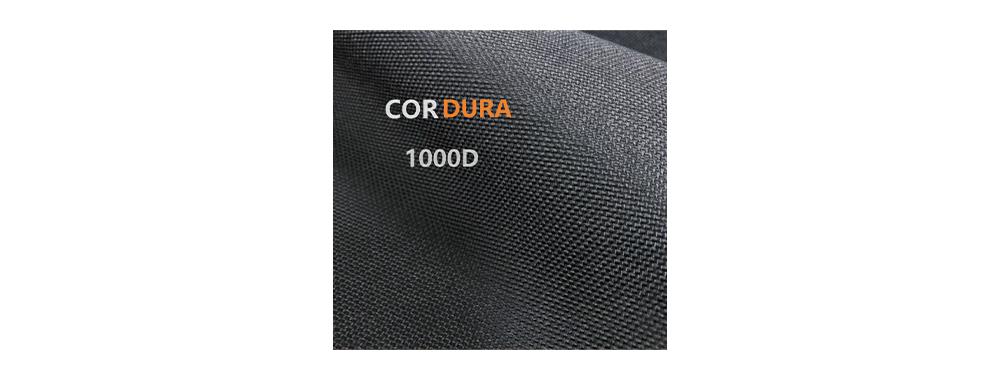
CORDURA® is a registered trademark of INVISTA and one of the oldest performance fabric brands in the world. The classic 1000D style — the undisputed workhorse of military packs, motorcycle gear and heavy-duty luggage — is woven from nylon 6.6 high-tenacity filament that is first air-texturized (air jets blow through the yarn to give it slight bulk and a matte, spun-like character), then woven in a tight plain weave (one over, one under), and finally finished with a PU back coating and a DWR face treatment.
Two details in that description are the core of what makes CORDURA® nylon what it is. First, nylon 6.6 has a slightly higher melting point and better abrasion behavior than the nylon 6 used in many generic fabrics. Second, air texturizing does something counterintuitive: making the yarn “fuzzy” actually improves abrasion resistance — because countless microscopic fiber loops on the yarn surface absorb the friction, instead of letting the load-bearing filament core take the wear directly.
3.2 What Are the Advantages of 1000D CORDURA® Nylon?
3.2.1 Functional: abrasion resistance is 1000D CORDURA’s core strength
INVISTA’s own comparative testing has long ranked 1000D CORDURA Classic ahead of generic 1050D/1680D ballistic nylon (Wyzenbeek and Taber-type tests), and the tactical and motorcycle gear industries — two of the harshest proving grounds for fabric — have confirmed this conclusion with decades of field experience. The tight plain weave locks every yarn firmly in place, and the matte finish hides scuffs exceptionally well. A black 1000D CORDURA pack dragged across a concrete loading dock will merely look a little worn.
3.2.2 Quality consistency
CORDURA also delivers quality stability and traceability. As a branded fabric produced by INVISTA-licensed mills to unified specifications, it performs identically regardless of where it is made. For brands managing production across multiple factories and multiple seasons, this uniformity and repeatability is a real advantage.
3.2.3 Brand trust
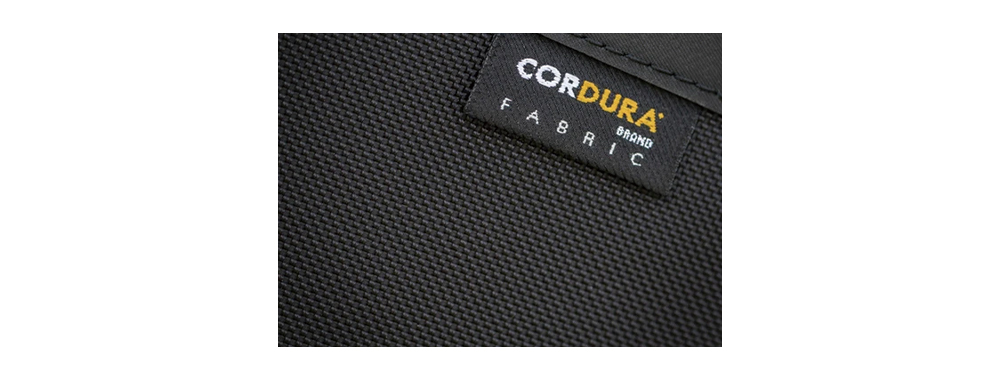
A genuine CORDURA hangtag on a backpack is a recognized quality signal to consumers in the outdoor and tactical markets.
3.3 What Are the Disadvantages of 1000D CORDURA® Nylon?
3.3.1 Tear strength is comparatively ordinary
A plain weave cannot shift and shed load the way a basket weave can. While 1000D CORDURA’s tear numbers are perfectly adequate, they do not dominate the way its abrasion numbers do. If your primary failure mode involves sharp objects — think tool rolls, chainsaw chaps, luggage thrown onto riveted cargo floors — ballistic nylon’s tear advantage is real.
3.3.2 Higher cost and MOQ barriers
Genuine CORDURA carries a significant price premium over generic 1680D ballistic nylon, must be sourced through authorized channels, and involves a hangtag licensing process if you want the label. For price-sensitive product lines, this needs careful evaluation before starting an outdoor backpack OEM project.
3.3.3 Appearance
The very feature that makes the surface scuff-proof — the matte, texturized feel — also makes it slightly prone to attracting dust and lint, with a drier hand feel and more muted colors. Some designers find it less premium than ballistic nylon’s silky sheen.
4. Head-to-Head Comparison Across All Dimensions
| Dimension | Winner | Key Reason |
| Abrasion resistance | 1000D CORDURA | Nylon 6.6 texturized yarn + tight plain weave; a consistent and substantial lead in Taber/Martindale standard tests — it directly determines how quickly a bag “shows its age” |
| Tear strength | 1680D ballistic nylon | Thick plied yarns + a 2×2 basket weave that shifts and sheds load; tears do not propagate easily — practically meaningful for sharp contents and cargo scenarios |
| Tensile strength | Tie | Both far exceed any real-world load; a backpack body never fails by being “pulled apart” |
| Puncture / snag resistance | 1680D ballistic nylon | Dense, smooth surface resists puncture and is not easily snagged |
| Water resistance | Tie | Determined by PU coating quality and curing — unrelated to the base weave or brand |
| UV / colorfastness | 1000D CORDURA (solution-dyed) | Piece-dyed versions of both are similar; CORDURA’s exclusive solution-dyed versions place the pigment inside the filament itself — an overwhelming colorfastness advantage under prolonged outdoor sun exposure |
| Weight | 1000D CORDURA | Usually slightly lighter at comparable performance, though both sit firmly in the heavy-duty class |
| Cost | 1680D ballistic nylon | Significantly lower fabric cost + zero licensing fees — the all-rounder of the mid-to-premium market |
5. How Should a Brand Choose?
Choose 1000D CORDURA when:
- The product lives in close contact with the ground: tactical packs, duffel bags, motorcycle bags, work and tool carriers;
- Long-term appearance consistency matters (team gear, rental equipment, institutional issue);
- The hangtag value can be monetized — outdoor, EDC and tactical customers recognize and trust the brand;
- You need solution-dyed colors, IR-compliant military specifications, or cross-factory, cross-season consistency.
Choose 1680D ballistic nylon when:
- The product is business luggage, a briefcase, or a premium-feel everyday bag, where the silky sheen is itself part of the quality expression;
- You need tear and puncture resistance (cargo, tools, sharp-edged contents);
- You need lower MOQ thresholds and a more responsive supply chain.
6. Frequently Asked Questions (FAQ)
Q1: Is 1680D ballistic nylon stronger than 1000D CORDURA?
It depends on the test. 1680D ballistic nylon usually posts higher tear strength, while 1000D CORDURA usually delivers better abrasion resistance. There is no all-around “stronger.”
Q2: Is ballistic nylon actually bulletproof?
No. The name is a 1940s marketing legacy — DuPont developed the original 1050D basket-weave nylon for flak jackets. Those jackets were designed to stop shell and grenade fragments — low-velocity shrapnel — not bullets, and today’s commercial ballistic nylon carries no ballistic rating whatsoever. What the fabric truly inherited from its military origins is an uncompromising pursuit of tear resistance.
Q3: What does the “D” in “1680D” mean?
Denier — the weight in grams of 9,000 meters of yarn. It measures yarn thickness, and only partially relates to durability.
Q4: Which fabric is more waterproof?
Neither fabric is waterproof by itself. Water resistance depends on PU coatings and DWR treatments, so it is determined by coating quality, not by weave or brand.
Q5: Why is CORDURA more expensive?
It is a branded, specification-controlled fabric, produced by licensed mills from nylon 6.6, with a hangtag system and lot-to-lot consistency — what you pay for is repeatability and brand equity, which matter as much as the performance itself.
Q6: Which fabric do premium luggage brands use?
Both. Several famous business luggage brands built their identity on ballistic nylon, while tactical and outdoor brands overwhelmingly specify CORDURA. The split reflects customer expectations rather than performance gaps.
7. Conclusion
1000D CORDURA® nylon is the more abrasion-resistant, more consistent and more hard-wearing-looking fabric, and it reinforces brand premium in high-intensity, ground-contact use. 1680D ballistic nylon, with its better tear strength, sleeker appearance and significantly friendlier price, holds the larger share of the mid-to-premium business backpack market. For backpack brands, fabric is only one item in the cost structure — the final product’s competitiveness also depends on pattern design, trim selection and workmanship.