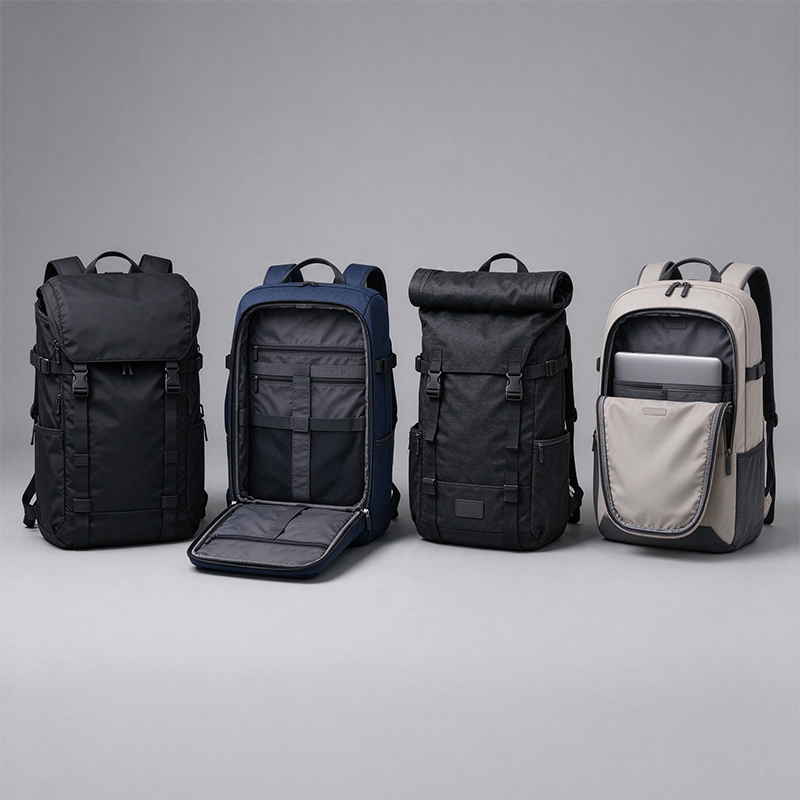
The manufacturing cost of a backpack is mainly determined by six major factors:
- Materials: Materials are the most intuitive component of backpack costs and the first link to be locked in along the entire cost chain.
- Design and process complexity: The number of cut pieces and special processes directly determine labor hours.
- Mold costs: Custom inputs such as cutting dies, hot-press forming molds, and hardware tooling are amortized into the unit price based on order volume.
- Order quantity: The larger the batch, the thinner the fixed costs such as sampling and molds are spread, and the stronger the bargaining power in material procurement.
- Quality standards and compliance requirements: Inspection levels and export certification testing requirements.
- Transportation terms and logistics: Different transportation terms will also generate some hard-to-notice unexpected costs.
1. Materials
1.1 Fabric: The largest portion of material costs. The cost of fabric must be calculated from five dimensions.
- Gram weight: For the same nylon or polyester, each step up in gram weight raises the price per meter accordingly, and gram weight directly corresponds to abrasion resistance and tear resistance. When selecting materials, brands often need to weigh this against their own product positioning.
- Finishing: Water-repellent coating has almost become a basic configuration. If PU or TPU backing, flame retardant, UV resistance, or antibacterial treatments are added, the unit price per meter will increase step by step.
- Technology and environmental premiums: For the same nylon, ordinary nylon and CORDURA® brand nylon differ greatly in price, with a technology premium added on top of functionality. The currently popular rPET recycled fabrics and X-Pac composite fabrics similarly carry obvious premiums beyond environmental friendliness and performance. If brands use such fabrics for flagship models, the cost structure rises accordingly.
- Width and cutting layout: Fabric width determines the layout efficiency of cut pieces. When the width is not suitable, the number of machine passes increases, the loss rate rises, and the wasted meters are ultimately converted into the cost of each backpack.
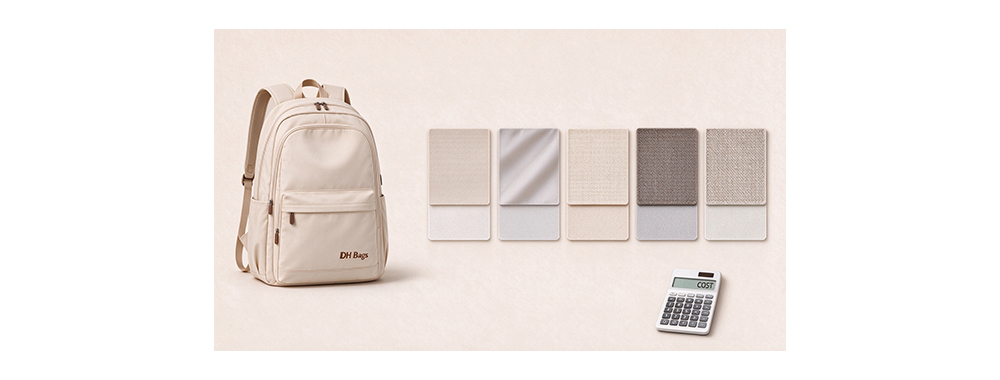
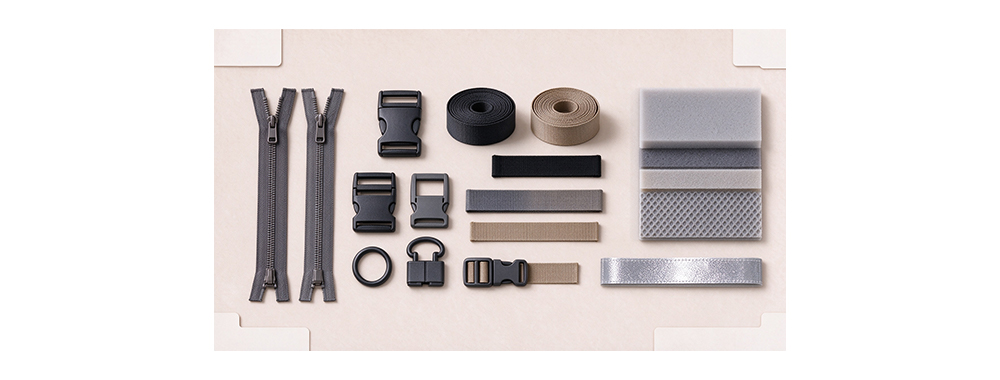
1.2 Accessories and Trims: A Small Share of Usage, but a Big Driver of Cost Tiers Accessories and trims are a part that is both important and easily underestimated. Although they account for only a small share of material usage, the differences between brands are significant, making them a key factor in separating cost tiers. The cost of trims mainly consists of the following components:
- Zippers: Zipper brands fall into several tiers. Riri (Switzerland), Lampo (Italy), and Raccagni (Spain) belong to the first tier; YKK (Japan), Ideal Fastener (USA), and Talon (USA) make up the second tier; while SBS (China), YBS (Taiwan, China), and 3F / YCC / Weixing (China) form the third tier, which is also the cost-effective choice for most mass-production styles. The price gap between zipper brands of different tiers can reach several times, making zippers one of the cost factors a brand should consider at the early sampling stage.
- Buckles: Buckles also come in different grades. Mainstream European and American brands such as FIDLOCK (Germany), ITW Nexus (USA), and Duraflex (USA) dominate the high-end market with their outstanding load-bearing performance and design, while more accessible Asian brands (such as Woojin (Korea) and YKK (Japan)) strike a better balance between manufacturing and value. Different buckle brands correspond to different positioning needs, and naturally there is a certain gap in price and cost as well.
- Webbing: Different materials and densities correspond to different costs. Nylon webbing outperforms polyester webbing in strength and hand feel, and is priced higher. For the same material, each step up in density and thickness brings a corresponding increase in unit weight and unit price.
- Lining and Padding: Lining may look insignificant, but it directly affects a backpack’s interior feel and durability. There is a clear price gap between ordinary polyester lining and high-density ripstop lining. As for padding, EVA, EPE pearl cotton, and various foams each involve trade-offs among resilience, weight, and cost. The comfort of the carrying system is largely determined by these materials — each step up in thickness and density raises the cost accordingly.
- Other Small Parts: The cost differences of items such as webbing adjusters, D-rings, cord locks, hook-and-loop fasteners, and reflective tape mainly lie in material and machining precision. The price gap between zinc alloy and plastic parts, or between a standard webbing adjuster and one with a self-locking mechanism, can be several times. Small parts with insufficient precision tend to cause jamming or looseness during assembly, indirectly driving up rework costs.
2. Design and Craftsmanship Complexity
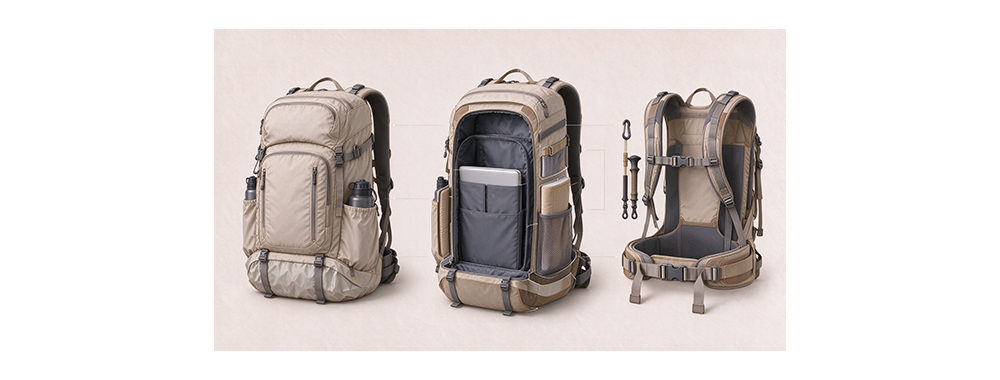
The complexity of design and craftsmanship is another key factor affecting backpack manufacturing costs. A minimalist backpack with 15 pattern pieces versus an outdoor backpack with 60 pattern pieces — even with identical materials, the labor hours can differ by more than double. The more pattern pieces there are, the more cutting, alignment, and stitching operations are required, and the higher the cost naturally becomes.
Functional structures act as an amplifier of craftsmanship costs: waterproof seam sealing tape, laser-cut MOLLE systems, heat-molded back panels, hidden anti-theft pockets, functional compartment designs… Each special technique requires dedicated equipment, skilled workers, and additional quality inspection steps.
This is also why experienced backpack factories, upon receiving a design with complex functionality from a client, always recommend completing a sample before providing an accurate quotation.
3. Mold and Tooling Costs
Mold costs are a hidden expense in backpack OEM, and the one most frequently overlooked by brands when calculating unit prices. Although backpacks are sewn products, custom designs involve various forms of tooling investment. Common types of molds include:
3.1 Cutting Dies: The most common type. Every pattern piece of fabric, lining, and foam is cut out with a cutting die. A single bag with dozens of pattern pieces requires dozens of die sets — the unit price per die is low, but the quantity adds up.
3.2 Heat-Molding Dies: The three-dimensional shaping of EVA back panels, shoulder straps, and hard-shell front panels requires custom heat-molding dies. This is where the bulk of mold costs for backpacks goes — a structurally complex molding die can cost several hundred US dollars.
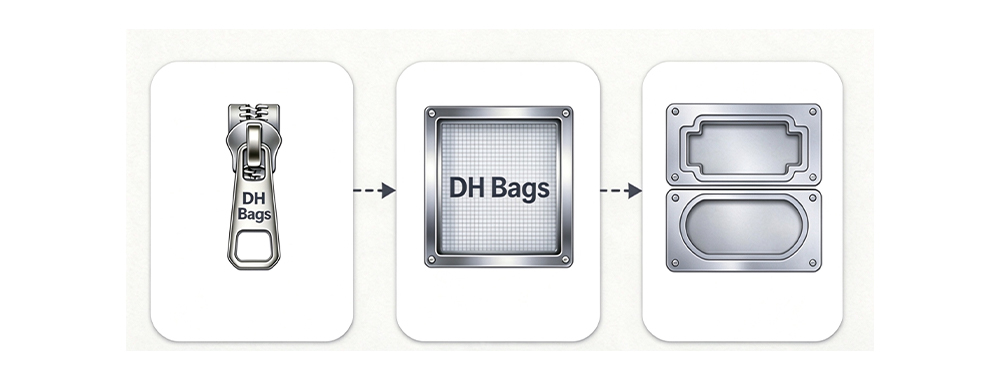
- Hardware/Plastic Tooling: Custom logo zipper pulls, proprietary-mold buckles, and injection-molded parts (bottom corner protectors, hooks, etc.) all require dedicated tooling, with costs depending on complexity.
- Printing/Stamping Plates: Heat transfer and screen printing plates, hot-stamping dies, woven label setups, etc. — the unit cost is low, but every design revision means making them all over again.
There are three cost logics behind mold expenses — practical insights from a bag manufacturing factory:
- One-time investment, amortized across the order: Mold costs do not vary with the materials of each individual bag; they are spread across the entire order. A $1,000 mold amortized over 1,000 bags adds $1 per bag; over 10,000 bags, it adds only $0.10 per bag — this is one of the hidden reasons why larger orders come with lower unit prices.
- Changes mean re-tooling: Once a mold is made based on a confirmed design, any subsequent change in dimensions or structure usually means scrapping the mold and starting over. Brands are therefore advised to confirm mold compatibility at the pre-production sample stage, and avoid design changes after tooling has begun.
- Mold ownership: When mold costs are paid by the brand, ownership typically belongs to the brand. Reorders then require no re-tooling, and this upfront investment turns into pure savings — it is no longer counted into the unit price again.
When the budget is limited, there is also a compromise: prioritize existing public tooling (off-the-shelf buckles, standard EVA shapes) and concentrate the proprietary-mold budget on the parts users perceive most directly — for example, a custom zipper pull with your logo. It doesn’t cost much, yet it instantly elevates brand recognition.
4. Order Quantity
The impact of order quantity on costs runs through virtually every cost item. Its most direct effect is diluting fixed costs:
4.1 Fixed Costs Are Diluted: A first order usually has to absorb a sampling fee of $70–500 per style. If the order quantity is small (e.g., 300 pieces), the cost allocated to each unit is relatively high; once the quantity exceeds 1,000 pieces, this item becomes almost negligible. Meanwhile, one-time expenses (such as molds and testing) are spread across more products, and the unit cost drops significantly.
4.2 Purchasing Volume Brings Pricing Power: The larger the purchase volume, the lower the unit price of fabrics — and the same applies to trims. Standard items such as zippers and buckles often come with minimum order quantity (MOQ) requirements. When the purchase volume falls short of the threshold, you either have to accept higher spot prices for small lots or be required to stock up on extra inventory, tying up cash flow.
4.3 Economies of Scale: Order quantity also changes how production is organized. Small orders can usually only run on flexible production lines or be scheduled together with other orders, which means frequent style changeovers and repeated machine adjustments, driving up the labor time allocated per unit. Large orders, on the other hand, can be assigned to dedicated lines with continuous operation; worker proficiency improves with repetition, and yield rate and efficiency improve in tandem. For the same backpack, the actual labor cost per unit at a few hundred pieces versus tens of thousands of pieces is often not on the same order of magnitude.
5. Quality Standards and Compliance Requirements
Molds and craftsmanship determine “what a bag can be made into,” while quality standards determine “what every single bag must be made into.” On the same production line, executing different quality standards leads to noticeably different costs.
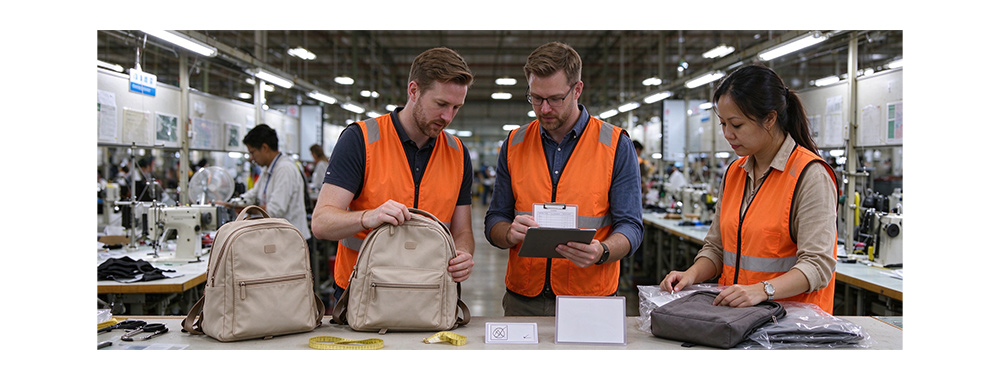
5.1 Quality Standards: Take the industry’s commonly used AQL sampling inspection standard as an example — the stricter the inspection standard (e.g., AQL 1.5 versus AQL 4.0), the more the factory must invest in in-process inspection, full inspection, and rework during production. These costs ultimately show up in the quotation.
5.2 Compliance Requirements: Testing and certification requirements commonly seen for exports to European and American markets — such as chemical tests like REACH, CPSIA, and California Proposition 65, as well as physical tests for color fastness, tensile strength, and load bearing — often require materials that meet specific compliance requirements to be custom-made, and customization typically costs a fair percentage more than off-the-shelf stock. More importantly, the testing itself comes with a price tag: chemical testing is charged per test item, and if a single bag covers multiple fabrics, linings, and colorways, the testing scope stacks up by material type, driving the fees up accordingly.
6. Shipping Terms and Logistics
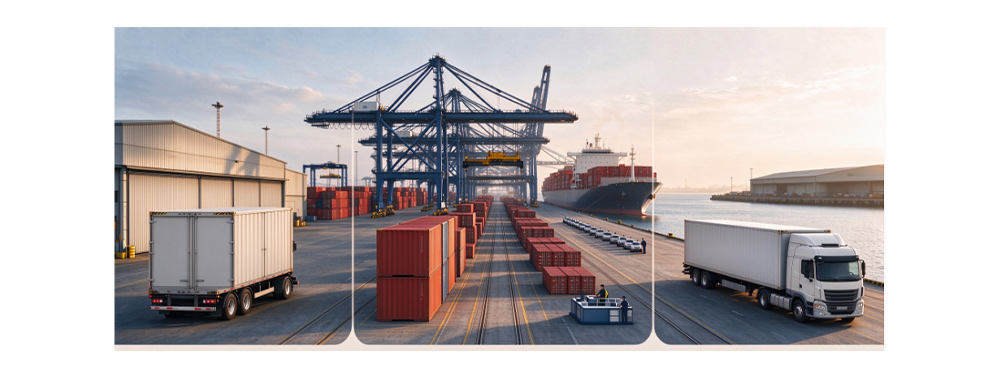
Different shipping terms can also generate unexpected costs that are easy to overlook. The most commonly ignored one is the division of responsibility defined by Incoterms. FOB, CIF, DDU, and DDP may look like just a few abbreviations, but in practice they carve out very different ranges of expenses:
- FOB: The factory is only responsible for delivering the goods to the designated port of shipment and completing export customs clearance. From the dock onward, ocean freight, insurance, destination port charges, import customs clearance, and inland delivery are all borne by the buyer.
- CIF: The seller is responsible for loading the goods on board the vessel and paying the ocean freight and insurance to the destination port. Once the goods are loaded on board at the port of shipment, the risk transfers to the buyer; import customs clearance, duty payment, and transportation beyond the destination port are all the buyer’s responsibility.
- DDU: The seller delivers the goods to the buyer’s designated destination (such as a warehouse), but is not responsible for import customs clearance or duty payment. The buyer handles import customs clearance and all applicable taxes and fees.
- DDP: Under DDP, the seller is responsible for the entire transportation, import and export customs clearance, and duties — the quotation must include all these items in advance. For the same backpack, the difference between an FOB unit price and a DDP unit price can be quite considerable.
In addition, the choice between LCL (less than container load) and FCL (full container load) also affects the per-unit cost. When the cargo volume is insufficient for a full container and ships as LCL, freight is charged by volume or weight, and you also have to bear destination port deconsolidation fees and consolidation service fees. These per-shipment charges are no small amount when allocated to each individual backpack. Once the cargo volume grows and you switch to FCL, the freight allocated to each unit drops noticeably.
7. FAQ
Q1: For the same backpack, why can quotations from two factories differ so much?
The gap in quotations often lies not in any single process, but in several overlooked variables.
- First, check whether the materials are of the same grade — both may be called “nylon,” but the per-meter price of ordinary nylon and branded functional fabrics can differ several times over.
- Next, look at the trim tiers — the price gap between first-tier and third-tier zippers and buckles is equally significant.
- Then verify the craftsmanship and number of operations, the inspection grade, whether mold costs have been amortized, and the Incoterm quoted — FOB or DDP, which entail completely different responsibility boundaries and cost ranges. Once these baselines are aligned, the price gap usually narrows considerably.
Q2: For a first OEM backpack order, how should the order quantity be decided?
Start by calculating the break-even point for amortizing fixed costs. Sampling fees, mold costs, and testing fees are all one-time investments — when the quantity is too small, the per-unit allocation pressure is obvious, and it usually takes 500+ pieces to enter a relatively reasonable range. Another constraint comes from material MOQs: fabrics and standard parts often have minimum purchase thresholds, and falling short means either accepting spot prices for small lots or stocking up in advance.
Q3: Can sampling fees be saved? When is sampling a must?
Styles with complex functionality and many special techniques are not where you should cut corners. For designs with numerous pattern pieces and complex craftsmanship, labor hours and assembly difficulty are hard to estimate accurately from drawings, and quotations based on experience alone tend to be off — quoting after sampling is actually closer to the true cost. For simple modifications of existing public designs, if the factory already has ready cutting dies and patterns, the sampling process can be appropriately simplified. However, we still recommend keeping the pre-production sample confirmation step, so that dimensions and mold compatibility are finalized before tooling begins.
Q4: Who should pay for the molds, and do they need to be paid again on reorders?
Molds are usually paid for by the brand, and upon payment, ownership of the molds belongs to the brand. Subsequent reorders require no re-tooling, and the cost is no longer counted into the unit price again. If the factory bears the cost instead, ownership stays with the factory, and mold costs are generally embedded in the unit price or the minimum order quantity — this eases the brand’s short-term cash flow pressure, but is not necessarily more cost-effective in the long run.
Q5: Roughly how are export certification and testing fees calculated?
Chemical testing is usually priced per test item, and physical testing is priced by test item and sample quantity — the exact amount depends on the laboratory’s quotation. The cost mainly depends on the scope of coverage: if a single bag involves multiple fabrics, linings, and colorways, testing must cover each material type separately, and the fees stack up accordingly.
Q6: Which item is most easily left out of a quotation?
Logistics-related costs and the costs of repeated design revisions during sampling are the most easily underestimated. Incoterms determine who bears ocean freight, insurance, destination port charges, and customs clearance — the difference between an FOB price and a DDP price for the same bag can be quite significant. When cargo volume is insufficient for a full container and ships as LCL, the per-shipment deconsolidation and consolidation service fees are no small amount when allocated to each unit. On top of that, repeated design revisions during sampling bring re-tooling costs for cutting dies and printing screens. These two items are usually not proactively listed in initial quotations, but they gradually surface as the project moves forward — their baselines and responsibility allocation need to be confirmed item by item with the factory before placing the order.
Q7: If material prices rise or exchange rates fluctuate, can the quoted price still be locked in?
A quotation’s validity is usually tied to raw material market conditions and exchange rate trends — the price a factory offers often only holds within a certain window. If the order cycle is long, consider placing orders in batches and locking in prices batch by batch, keeping the risk of any single price fluctuation within a tolerable range.
Q8: With small quantities and many styles, how can costs be controlled?
The core tension with small orders and multiple styles is that fixed costs get diluted over and over again. A workable approach is to first consolidate the styles — concentrate colorways and material types into a few groups, so that cutting dies, printing screens, and testing coverage can be reused as much as possible. Then focus the parts that truly need differentiation on just a few points, such as a custom zipper pull or an exclusive colorway, while using public trims and standard patterns for everything else. At the same time, you can agree with the factory to complete sampling and revisions within a single time window, reducing production scheduling changeovers and minimizing the machine-adjustment losses caused by switching styles.
8. Conclusion
Looking back, a backpack’s manufacturing cost is the result of layers upon layers of factors. Truly professional sourcing is not about squeezing the quotation down to the lowest possible number, but about understanding the value behind every cost item — knowing which money should be spent (quality that users can perceive, compliance that cannot be compromised) and which money can be saved (excessive structures, redundant colorways) — and building on that foundation a transparent cost communication mechanism with the bag factory.