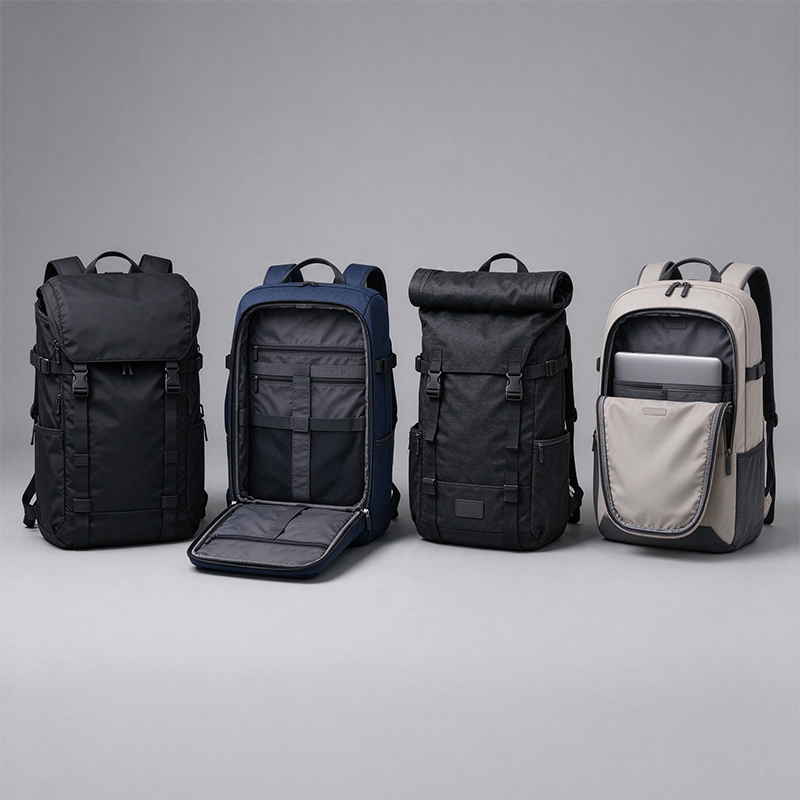
There are four mainstream main-compartment opening types on the market: Vertical-Load, which provides vertical access from the top; 270° Clamshell, which opens flat like a suitcase; Roll-Top, which closes by rolling and folding the opening; and U-shaped or D-shaped opening on the front panel. This article breaks down these four common constructions, explaining their design features, advantages, limitations, and ideal applications, and also introduces several commonly used secondary opening variations.
Ⅰ. Four Main Opening Types for Backpack
1. Vertical-Load
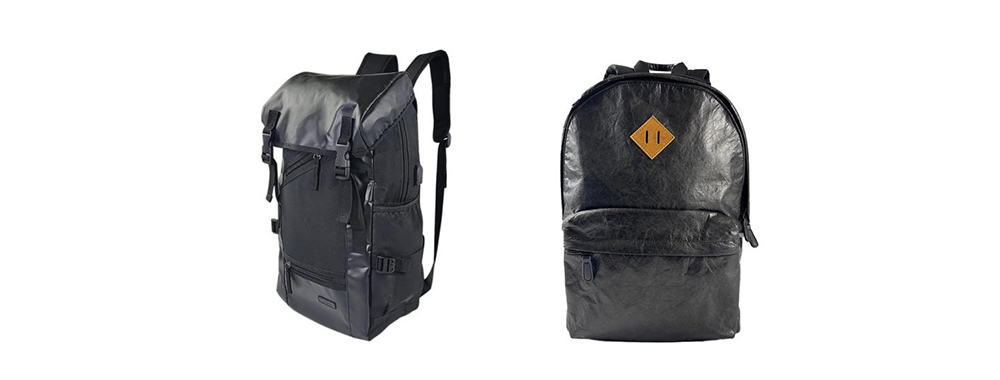
Construction: The main-compartment opening is located at the top of the backpack, with items packed vertically. Two common designs are available. The classic hiking-pack version uses a drawstring or zipper closure, a top lid, and buckles. The other, commonly found on school backpacks and casual daypacks, uses a curved or horizontal zipper at the top without a drawstring closure or separate top lid. Both are deep, vertically oriented compartments accessed from above.
Advantages
• Simple construction with fewer zippers, lower weight, fewer potential failure points, and good durability.
• The deep vertical compartment accommodates long or stacked items such as tents, sleeping bags, and books.
• Models with a top lid and compression straps generally offer better protection against rain and splashes.
Limitations
• Items are stacked vertically, so reaching gear at the bottom usually requires removing the items above it.
• Built-in organization is limited; packing cubes or organizer pouches may be needed to keep items tidy.
Best for: School backpacks, everyday casual backpacks, multi-day hiking packs, and camping or mountaineering backpacks. This construction is used across a wide range of sizes, from compact casual bags to 30–65 L expedition-style hiking packs.
Important distinction: Many backpacks have a U-shaped zipper at the top, but the front panel remains fixed and does not open outward. These are still Vertical-Load designs. In a Vertical-Load backpack, the U- or D-shaped zipper runs along the edge of the front panel, allowing the entire panel to fold outward. The two designs should not be confused.
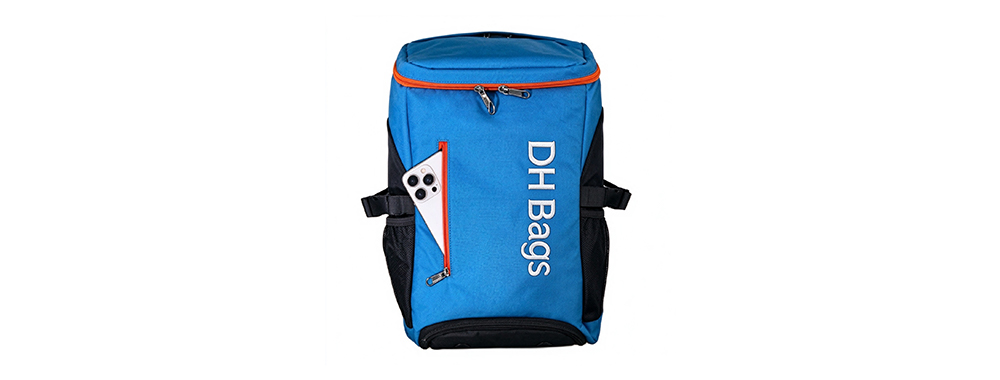
2. Clamshell Opening (Fully–open type)
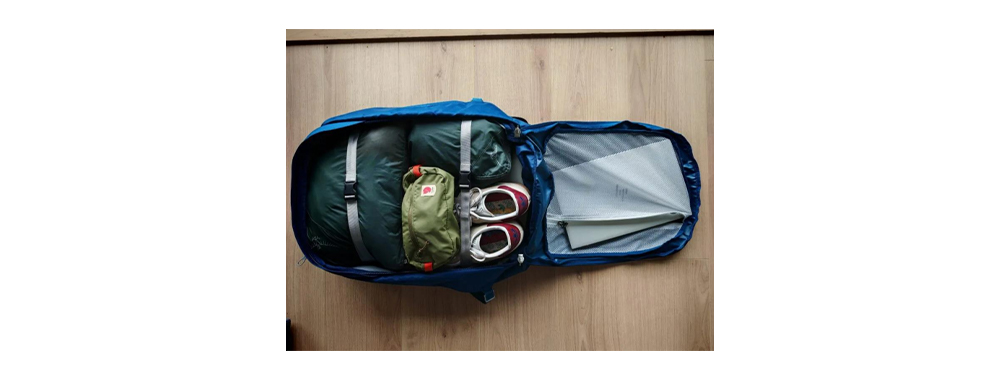
Construction: A zipper runs around three sides of the bag, creating what the industry commonly calls a 270° clamshell opening. When unzipped, the backpack opens fully flat into two separate halves, much like a suitcase. The key difference from a U-shaped front-panel opening is that the bag separates into two sides.
Advantages
• The contents are easy to see at a glance, making this design ideal for use with packing cubes.
• A laptop can be removed quickly at airport security, and packing for multi-day trips is more efficient.
• Each half can have its own compartments, enabling highly modular organization.
Limitations
• The long zipper path makes high-level water resistance more demanding: waterproof zippers and seam-taping processes are often required. The zipper is also one of the bag’s main wear points.
• The backpack needs a flat surface to open fully, making access inconvenient in crowded trains or other confined spaces.
Best for: Multi-day travel, business trips, tech organization, and users who prefer packing cubes.
3. Roll-Top Opening
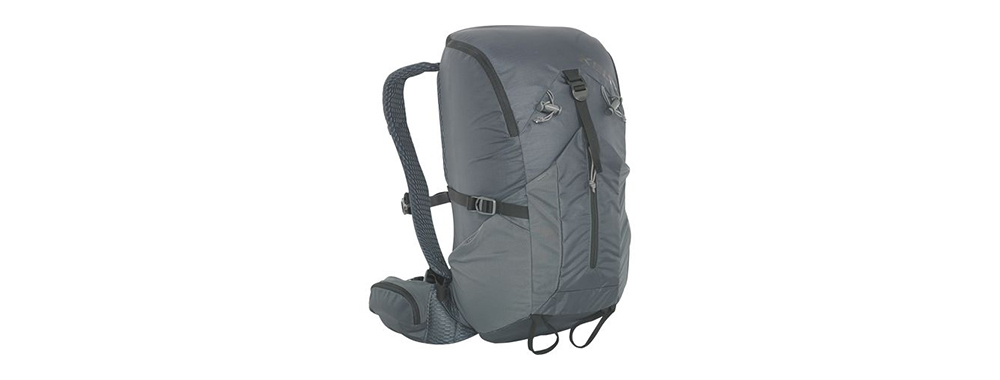
Construction: An extended fabric sleeve at the top is rolled down several times and secured with webbing and buckles. Many designs also add a small front zipper for quick access.
Advantages
• Adjustable capacity: roll the top down more when carrying less, or use fewer rolls when carrying a larger load.
• The multiple folded layers provide excellent resistance to splashes, making this a common construction for water-resistant backpacks. When paired with suitable materials, it can deliver a high level of splash protection.
• With no long zipper on the main compartment, the design can be more durable in dusty or damp environments.
Limitations
• Opening and closing takes several steps, slowing access. Without an additional quick-access zipper, items at the bottom can be difficult to reach.
• Repeated rolling and folding can leave creases, which may become more susceptible to aging and wear.
Best for: Urban cycling, everyday use in rainy climates, water sports, and situations where load volume varies.

4. U-Shaped / D-Shaped Opening (180° opening)
Construction: A U- or D-shaped zipper allows the front panel to fold outward while the main body remains in one piece. Unlike a 270° clamshell design, the backpack does not split into two halves and lie completely flat. This construction balances convenient access with low weight and is widely used for commuter and camera backpacks.
Advantages
• A laptop and accessories can be accessed while the backpack is standing upright; no flat surface is needed.
• The opening is wider than that of a Top-Load design, while the weight increase is typically lower than with a clamshell construction.
• It readily accommodates a padded laptop sleeve and is well suited to electronics and camera gear.
Limitations
• If the front panel is not reinforced adequately, it may bulge, sag, or deform when the backpack is fully loaded.
• Stress concentrates at the corners of the U-shaped zipper. For water-resistant models, seam taping around these corners is more technically challenging.
Best for: Office commuting, camera backpacks, school backpacks, and lightweight short trips.
5. Quick Comparison and Selection Guide
Comparing these four styles reveals a general trade-off: the larger and flatter the opening, the faster access tends to be—but the longer the zipper, the greater the weight, and the more challenging waterproofing becomes. Smaller or rolled openings generally provide better sealing potential and lower weight, but slower access. Vertical-Load and Roll-Top designs trade access speed for simpler construction and better sealing potential. Clamshell and U-Shaped designs use more complex construction and may cost more, but provide more efficient access. No design is perfect for every use case; each involves trade-offs.
The table below provides a quick comparison of the four main opening styles:
| Opening Type | Access speed | Main drawbacks | Best applications |
| Vertical-Load | Slow | Difficult to reach items at the bottom without removing gear above | School and casual backpacks; hiking, camping, and long-distance outdoor use |
| 270° Clamshell | Fastest | Heavier; long zipper; higher waterproofing costs; requires a flat surface to open fully | Multi-day travel and business trips |
| Roll-Top | Slowest | More steps to open and close; creases may wear over time | Cycling, rainy conditions, and variable loads |
| U-/D-shaped | Fast | May sag without adequate reinforcement; corner seam taping is challenging for water-resistant models | Commuting, camera bags, and school backpacks |
Ⅱ. Hybrid and Specialized Secondary Openings
The four basic main-compartment opening types described above cover the core access needs of most backpacks. In specialized categories such as outdoor packs, camera bags, and anti-theft commuter backpacks, designers often add extra zippers or combine multiple base constructions. These are hybrid or secondary openings rather than independent main-compartment opening types, and can be configured to meet specific sourcing requirements:
• Y-access (three-zipper Y-shaped opening): A variation of a clamshell or U-shaped front-panel design, using a Y-shaped zipper layout. It allows partial quick access or full opening and is commonly used on expedition hiking packs and tactical backpacks. Multiple zipper junctions make seam taping more complex on water-resistant versions.

• Side-zip access: A vertical zipper added to the side of a Vertical-Load backpack lets users reach items inside without unloading gear from the top. On water-resistant models, the additional seam allowance must be seam-taped separately.
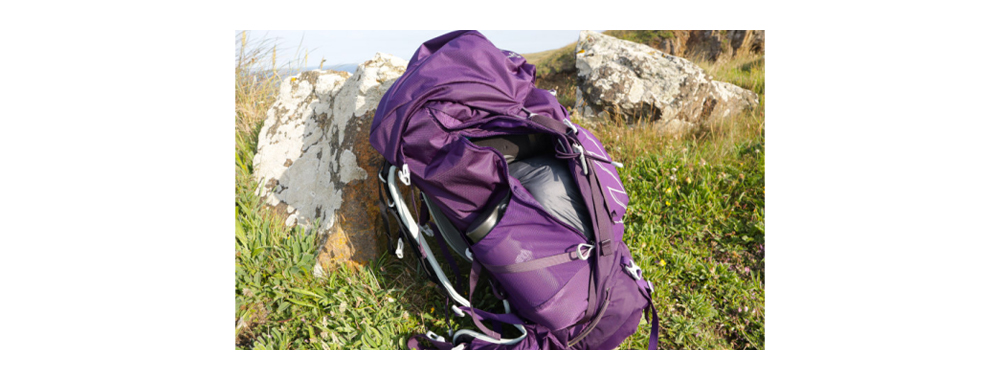
• Back-panel access: An anti-theft zipper is positioned on the side that rests against the wearer’s back. The backpack must be removed to open it. This feature is common on anti-theft commuter bags and premium camera backpacks.

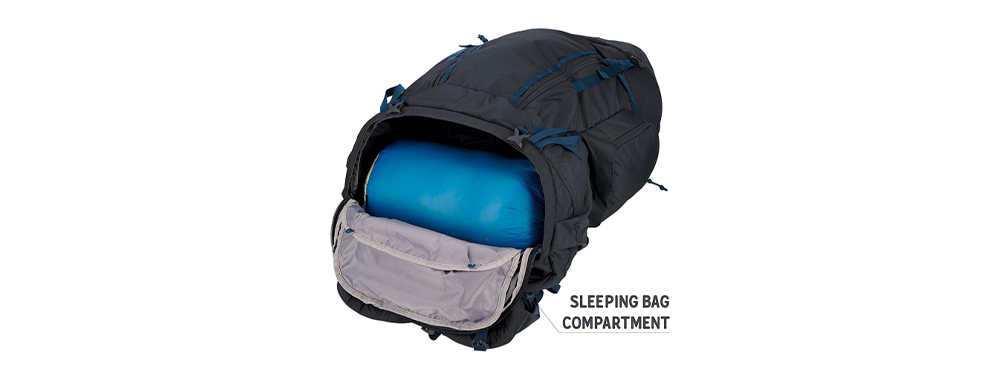
• Separate bottom-compartment opening: Large Vertical-Load backpacks may have a dedicated bottom compartment for a sleeping bag or sleeping pad. Because the bottom zipper is exposed to dirt, grit, and moisture, its water resistance and long-term durability require particular attention.
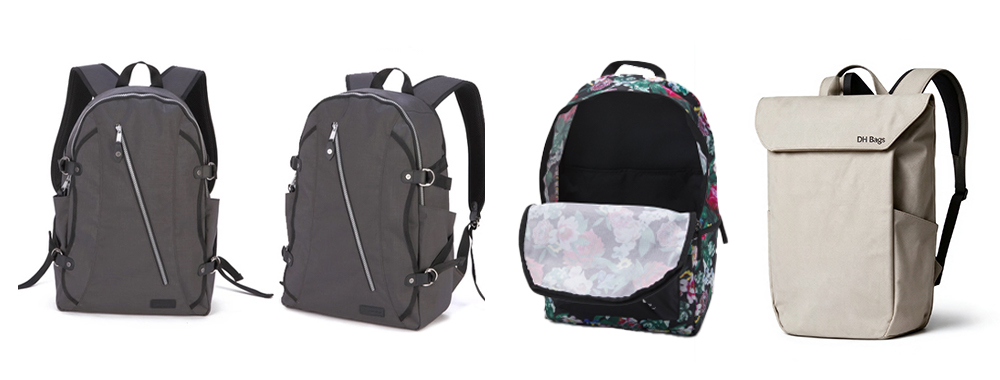
• Angled zippers, fan-shaped openings, and full-panel flap closures with magnetic fasteners are all variations derived from Vertical-Load or U-shaped constructions.
Ⅲ. Frequently Asked Questions (FAQ)
Q1: Which opening style is best for a waterproof backpack?
A: Roll-Top designs have the greatest sealing potential because multiple folds help reduce water ingress. However, a roll-top closure alone does not make a backpack waterproof. Full waterproof performance depends on the fabric, PU/TPU coatings, waterproof zippers, and fully seam-taped seams working together. Clamshell and U-shaped designs can also be made water-resistant, but they generally require higher component and manufacturing costs as well as stricter quality control. A Vertical-Load backpack with a lid can handle light rain, but is not ideal for demanding waterproof applications.
Q2: Can a backpack combine two opening styles?
A: Yes. Hybrid constructions are common in backpack OEM projects—for example, a Vertical-Load main compartment with side-zip access, or a Roll-Top bag with a U-shaped front-panel quick-access opening. Combining constructions increases manufacturing complexity and cost. For water-resistant products, each additional zipper seam must be seam-taped separately.
Q3: How can I quickly tell a U-shaped backpack from a 270° Clamshell?
A: The distinction is simple: a true 270° clamshell opens into two halves and lies completely flat. A U-shaped backpack only folds its front panel outward, while the body remains in one piece.
Q4: Which opening style is best for a commuter laptop backpack?
A: Commuter laptop backpacks in the mass-market price range often use a Vertical-Load design because it is simple, lightweight, and cost-effective for everyday office use. These bags usually have a separate laptop compartment at the back. In basic designs, this compartment can only be accessed from the top. When the main compartment is fully packed, its contents can obstruct access, forcing users to reach in without a clear view. Adding a dedicated side laptop zipper—a hybrid secondary opening—can significantly improve access speed.
For mid- to high-end products aimed at users who want reliable, unobstructed access to their laptop, a U-shaped front opening is a strong option. With the backpack standing upright, opening the front panel provides direct access to the laptop compartment, regardless of how full the main compartment is. It balances access efficiency, added weight, and cost.
For travelers who fly frequently and rely on packing cubes, a 270° clamshell design may be the better choice.
If water resistance is required, the design can also be upgraded with seam-taped construction and water-resistant zippers.
Q5: What is a Y-shaped three-zipper construction?
A: A Y-shaped three-zipper construction is a zipper variation based on a clamshell or U-shaped front-panel design. The multiple zipper junctions make waterproof seam taping more difficult, so this feature is generally used in premium hiking and tactical product lines aimed at demanding users.
Ⅳ. Conclusion
When choosing a backpack opening, no single construction is universally best. The right choice depends on the intended use case. Selecting the main opening is a fundamental design decision that affects the user experience, bill of materials , and final product cost.
If you are developing a backpack and need help choosing the right construction, feel free to contact us. As a professional bag manufacturer, we have experience producing backpacks with a wide range of opening designs for OEM/ODM projects and can provide expert guidance on selecting the right solution.