For business professionals commuting daily, the biggest concern isn’t running late for meetings—it’s whether their laptop will survive the crowded subway or an accidental drop. As a brand owner, does your custom business laptop backpack truly solve this pain point? Is the compartment design rational? Does the shockproof engineering meet standards? These factors directly impact end-user repurchase rates and brand reputation.
If you are looking for a Laptop Backpack OEM partner or planning to develop a Business Backpack product line, this guide will help you make informed design decisions, communicate efficiently with manufacturers, and reduce sampling revisions.
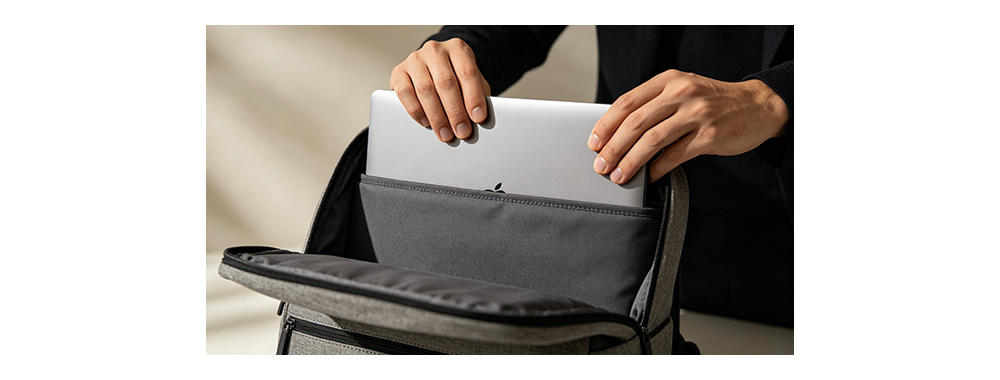
I. Core Compartment Design for Business Laptop Backpacks
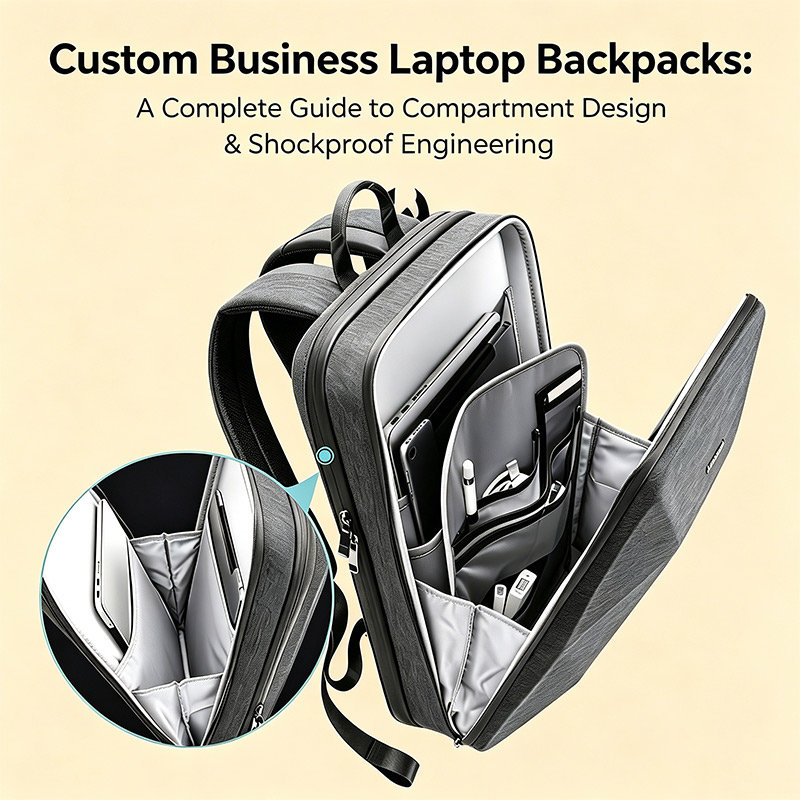
Compartment design isn’t about having more pockets—it’s about ensuring every space has a clear functional purpose. Here are the five core compartments you must decide on during custom development.
1.1 Main Laptop Compartment
This is the technical core of the entire backpack. When communicating with the factory, you need to confirm the following parameters:
| Design Element | Options | Applicable Scenarios |
| Size Compatibility | 13-14″ / 15-16″ / 17″ | Determined by target market laptop size distribution. 15-16″ dominates Western markets; 13-14″ is more common in Asia. |
| Securing Method | Velcro Strap / Elastic Band / None | Premium products should include straps to prevent device movement and impact against compartment walls. |
| Opening Direction | 180° Lay-flat Opening / Top Zipper Opening | 180° opening enables quick airport security access—a major plus for business travel scenarios. |
| Independent Layer | Single Laptop Compartment vs. Dual (Laptop + Tablet) | Dual-layer design can increase product premium by 15-20%, ideal for high-end business positioning. |
Our Recommendation: Provide your target user scenario list to your Custom Laptop Bag Factory. The factory can then optimize laptop compartment positioning—commuter models should place the compartment close to the back for weight balance, while travel models benefit from independent side openings for security checkpoint convenience.
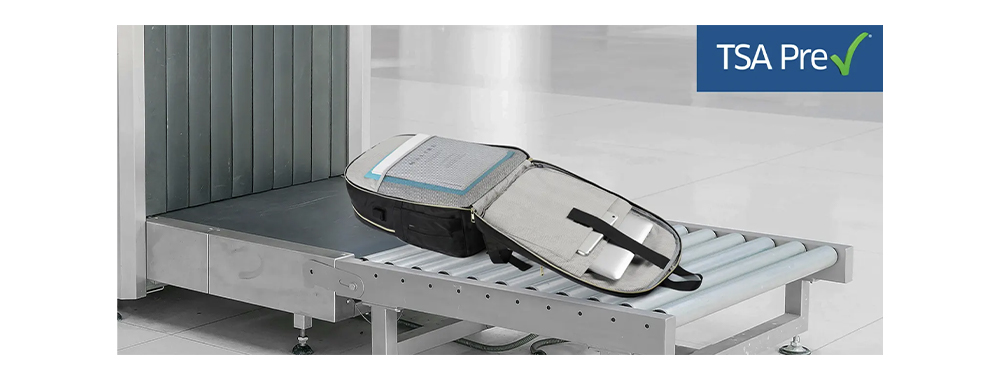
1.2 Document & File Compartment
Business backpacks must accommodate A4 documents without creasing. This detail is often overlooked by brand owners but is a highly sensitive pain point for end users. Recommendations:
• Document compartment width ≥ 23cm, height ≥ 32cm
• Soft divider between document compartment and laptop compartment to prevent metal device edges from scratching paper files
1.3 Accessory Organization System
Chargers, mice, cables, power banks—disorganized storage of these items is a primary source of negative reviews for business backpacks. Recommended design features:
• Elastic Mesh Pockets: Secure irregularly shaped items (e.g., mouse)
• Zippered Half-Open Pockets: Prevent small items from sliding to the bottom and becoming difficult to retrieve
• Pen Slots: 2-3 slots, essential for business scenarios
1.4 Quick-Access Front Pocket & Hidden Security Pocket
High-frequency access items (phone, business cards, transit cards) should be retrievable within 3 seconds. Meanwhile, valuables like passports and wallets require anti-theft design:
• Quick-Access Front Pocket: Magnetic closure or YKK quick-release zipper for one-handed operation
• Hidden Security Pocket: Positioned at the back panel against the body or inside shoulder straps, with concealed zipper

II. Shockproof Engineering: The Key to Protection Performance
Even the best compartment design will fail drop tests if shockproof engineering is inadequate. Shock protection isn’t simply adding a piece of foam—it’s a systematic engineering effort involving materials, structure, and manufacturing processes.
2.1 Cushioning Material Selection
As a Business Backpack Manufacturer, we offer four mainstream solutions based on client product positioning:
| Material Type | Core Characteristics | Cost Level | Target Positioning |
| EPE Pearl Cotton | Lightweight, excellent cushioning, heat-press moldable | Medium | Mainstream business backpacks, best value option |
| EVA Foam | High hardness, strong support, die-cuttable into complex shapes | Medium-High | Premium laptop backpacks, superior protection performance |
| Memory Foam | Slow rebound, contours to device shape, premium tactile feel | High | High-end gift market, brand premium products |
| Air Cushion / Air Bladder Structure | Ultra-lightweight, tech-forward, strong visual impact | Medium-High | Differentiated innovative products, ideal for crowdfunding or concept designs |
Selection Guidance: For target retail prices in the $30-50 range, EPE pearl cotton with appropriate thickness is sufficient for daily protection. For $80+ premium positioning, EVA or memory foam is recommended, with the cushioning material type clearly labeled on product pages—a significant B2C selling point.
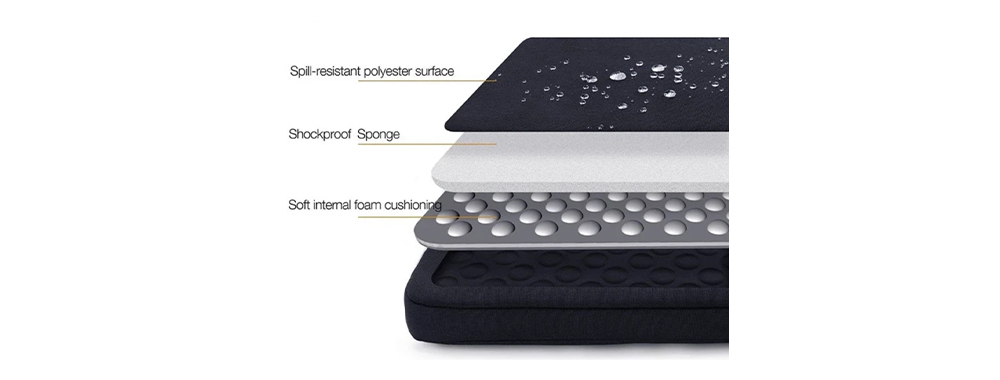
2.2 Shockproof Structural Design
Materials are only the foundation; structure determines drop protection rating. We discuss three structural solutions in detail with brand owners:
Solution A: Suspended Laptop Compartment
The laptop compartment maintains 1-2cm clearance from the backpack shell on all sides. During impact, force is attenuated through outer layers and cushioning before reaching the device. This is the current standard configuration for mid-to-high-end business backpacks.
Solution B: Reinforced Bottom Cushioning
The backpack bottom is the highest-risk drop zone. We recommend dual-layer cushioning: outer EPE (energy absorption) + inner EVA (support), or adding a rigid PP base plate at the bottom to disperse impact force.
Solution C: 360° Full-Wrap Protection
Cushioning layers on all six sides of the laptop compartment. Ideal for products requiring ISTA 1A drop testing or high-value device protection. Cost increases by approximately 15-20%, but significantly reduces after-sales issues.
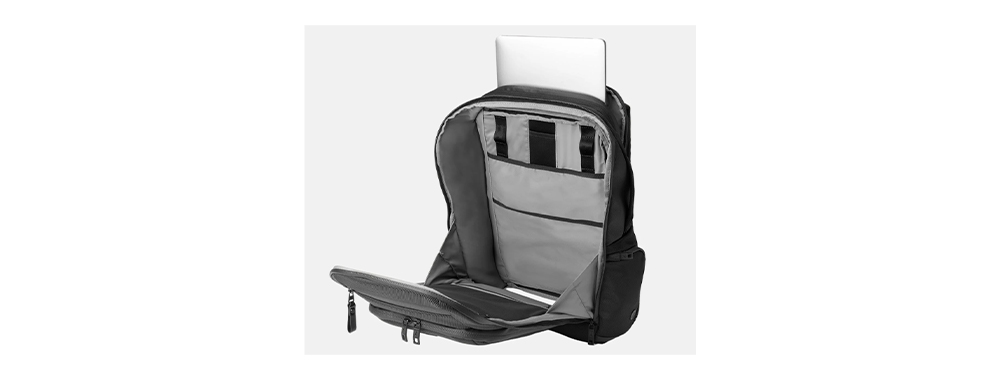
2.3 Fabric-Shockproof Synergy
Shock protection is a system engineering effort; outer fabric also participates in energy absorption:
| Layer | Material Recommendation | Function |
| Outer Layer | 1680D Ballistic Nylon or 900D Oxford | Abrasion-resistant, tear-resistant, provides initial cushioning |
| Middle Layer | Cushioning Material (EPE/EVA/Foam) | Core energy absorption and support |
| Inner Lining | Soft Polyester or Suede Lining | Prevents device surface scratches, enhances tactile feel |
Note: Overly soft outer fabric (e.g., thin polyester) cannot provide sufficient initial cushioning, causing middle-layer materials to reach compression limits prematurely. Business laptop backpacks should use outer fabric no less than 600D Oxford or equivalent strength material.
III. Custom Development Process: From Requirements to Sample
When working with a Laptop Backpack OEM factory, clear requirement transmission can reduce sampling lead time by over 50%. Here is the standard collaboration process:
3.1 Requirements Confirmation Phase (Day 1-3)
Please provide the factory with the following information:
• Target laptop size range (precise to inch)
• Target retail price range (determines material and process grade)
• Target market (Europe/America/Japan/Korea/Middle East—affects size preferences, compartment habits, and design style)
• Drop test standard requirements (e.g., ISTA 1A, MIL-STD-810G)
• Estimated first-order quantity (affects MOQ negotiation and material selection)
3.2 Design Sampling Phase (Day 4-15)
• Factory provides 2D/3D compartment structure diagrams or physical prototype bags
• Confirm cushioning material thickness, density, and coverage area
• Physical load testing: Place target laptop + daily items (charger, documents, water bottle) and evaluate:
– Space utilization rationality
– Whether center of gravity shifts backward causing shoulder fatigue
– Zipper smoothness under full load
3.3 Mass Production Phase
• Laptop compartment size tolerance controlled within ±0.5cm
• Cushioning material cutting precision inspection (edge burrs affect assembly)
• Finished product random drop testing (recommend 3-5 units per batch)
IV. Common Design Pitfalls & Avoidance Strategies
| Design Pitfall | Resulting Problem | Solution |
| Oversized Laptop Compartment | Smaller laptops shift around, cushioning cannot conform, protection fails | Offer multiple size SKUs or add adjustable Velcro straps |
| Excessive Fragmented Compartments | Wasted capacity, users cannot find items, negative experience | Follow the “3-Second Retrieval” principle, limit compartments to 5-7 |
| Neglected Weight Balance | Fully loaded center of gravity shifts backward, shoulder fatigue, poor carrying experience | Laptop compartment must be positioned close to the back; heavy items aligned with body center of gravity |
| Insufficient Cushioning Thickness | Inadequate protection, high after-sales complaint rate | Match cushioning thickness to product positioning; never compromise baseline protection |
V. Frequently Asked Questions (FAQ)
Q: What is the Minimum Order Quantity (MOQ) for custom business laptop backpacks?
A: Standard models start at 500 units per color. MOQ may be adjusted for special cushioning structure molds or exclusive hardware. We can offer flexible solutions based on your order scale.
Q: How long does the sampling process take?
A: Standard compartment designs take 7-10 days; special cushioning structures (e.g., EVA die-cut compartments) or custom hardware require 15-20 days.
Q: Can we develop brand-exclusive compartment structures?
A: Yes. We provide full-process ODM services from structure design to sample production, supporting patented compartment solutions with NDA protection.
Q: Do you support eco-friendly material options?
A: Yes. We offer RPET recycled Oxford, solvent-free PU coating, recyclable EPE, and other sustainable materials to meet brand ESG sourcing requirements.
Conclusion
Business laptop backpacks are highly functional products. The rationality of compartment design and the professionalism of shockproof engineering directly determine end-user repurchase intent and brand reputation. As a Business Backpack Manufacturer with years of expertise in bag manufacturing, we understand every decision concern B2B buyers face during custom development—from size compatibility to cushioning materials, from compartment ratios to drop testing.
Ready to develop your business laptop backpack product line?
Contact us for free design consultation and sample quotation. We provide one-stop Laptop Backpack OEM custom services—from compartment structure design and cushioning material selection to finished product testing—helping you build competitive business backpack products.