- Q1: What is the difference between bag OEM and ODM? Which one is more suitable for my brand?
- Q2: I only have a concept sketch without professional design drawings. Can the bag factory help bring it to life?
- Q3: Will the factory sign a Non-Disclosure Agreement (NDA) to protect my design?
- Q4: What is the typical MOQ for regular bag production? Is small-batch testing feasible?
- Q5: How long does it take from design drawings to pre-production samples for custom bags? How are the costs calculated?
- Q6: What information do I need to provide to the factory?
- Q7: Will the samples and bulk production end up being “different from the approved version”?
- Q8: Can design modifications be made repeatedly during the bag customization process? Is there a limit on the number of revisions?
- Q9: How much impact do fabric and hardware choices have on the cost of custom bags?
- Q10: What material options are available for B2B bag manufacturing?
- Q12: What are the different ways to apply logos and branding, and what are their respective advantages and disadvantages?
- Q13: How long does bulk production for custom bags typically take?
- Q14: How can I avoid bulk production delays during the bag OEM process?
- Q15: What are the quality inspection standards for bag factories?
- Q16: What certifications do bag factories need to have to export to the European and U.S. markets?
- Q17: Can the packaging be customized? What does it include?
- Q18: Can bags be shipped in batches after customization is completed? How should warehousing and logistics be arranged?
- Q19: What should I do if quality issues are found in the bulk production?
- Q20: How can I establish a long-term and stable relationship with a factory?
- Conclusion
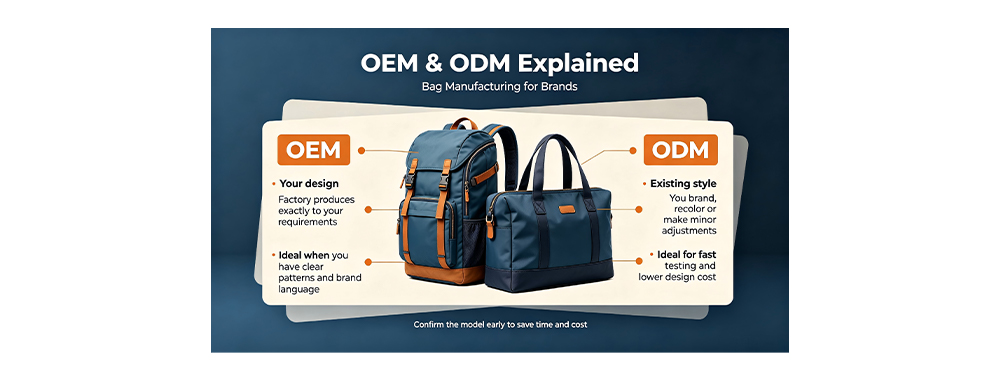
Q1: What is the difference between bag OEM and ODM? Which one is more suitable for my brand?
- OEM (Original Equipment Manufacturing) refers to the process where you provide design drawings or samples, and the factory produces according to your requirements.
- ODM (Original Design Manufacturing) refers to the process where the factory provides existing designs, and you customize them through branding, color changes, or minor modifications.
If your brand already has a clear design language and specific requirements for shapes and structures, OEM is more suitable. If you want to test products quickly and reduce initial design costs, ODM is a more practical starting point. Many factories support both models. The key is to clarify the development approach at the beginning of the cooperation to avoid time and cost losses caused by switching directions midway.
Q2: I only have a concept sketch without professional design drawings. Can the bag factory help bring it to life?
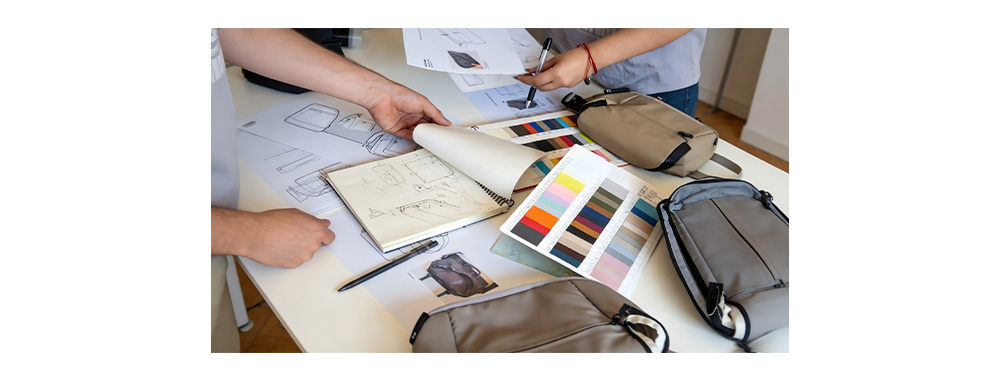
Yes, but it depends on the factory’s capabilities. Some factories have in-house design teams that can transform sketches into production-ready Tech Packs (technical specification packages); while execution-focused factories require you to provide complete measurement drawings, material lists, and production process instructions.
It is recommended to ask directly during the initial communication: Does the factory provide free design support? How many rounds of design revisions are included? These factors determine whether you need to hire an additional designer or whether you can rely on the factory to complete the transformation from concept to sample.
Q3: Will the factory sign a Non-Disclosure Agreement (NDA) to protect my design?
Professional factories are usually willing to sign an NDA, especially when you provide original designs or exclusive patterns. It is recommended to clarify intellectual property ownership, confidentiality periods, and breach clauses before exchanging any design files.
Q4: What is the typical MOQ for regular bag production? Is small-batch testing feasible?
The MOQ in the bag industry varies greatly. For basic canvas or polyester bags, factories can normally accept orders starting from 300–500 pieces; while styles involving custom hardware, special fabrics, or complex craftsmanship may require an MOQ of 1,000 pieces or more.
For emerging brands, small-batch testing is key to controlling trial-and-error costs. Choosing a factory that supports flexible MOQs allows you to validate market response with less investment before deciding whether to scale up production.
Q5: How long does it take from design drawings to pre-production samples for custom bags? How are the costs calculated?
- A standard bag typically takes around 7–15 business days from the design artwork to the pre-production sample. Styles with complex structures or those requiring mold development may take 20–25 days.
- Sampling fees are usually charged based on the complexity of the design, generally ranging from a few hundred to over a thousand US dollars.
Q6: What information do I need to provide to the factory?
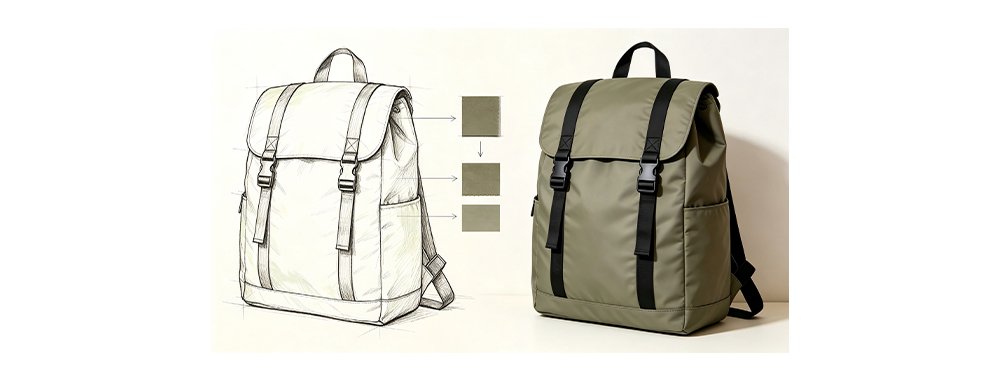
A complete Tech Pack should include:
- Design renderings or physical samples
- Dimensions and tolerance requirements for each part
- Specifications for materials such as outer fabric, lining, hardware, zippers, etc.
- Logo application process and placement specifications
- Packaging requirements (hangtags, care labels, carton specifications)
The more detailed the information, the lower the likelihood of rework during the sampling process. If you are temporarily unable to provide a complete Tech Pack, at minimum, prepare reference samples and a detailed requirements document.
Q7: Will the samples and bulk production end up being “different from the approved version”?
This is one of the biggest concerns for brands. There are three key control measures:
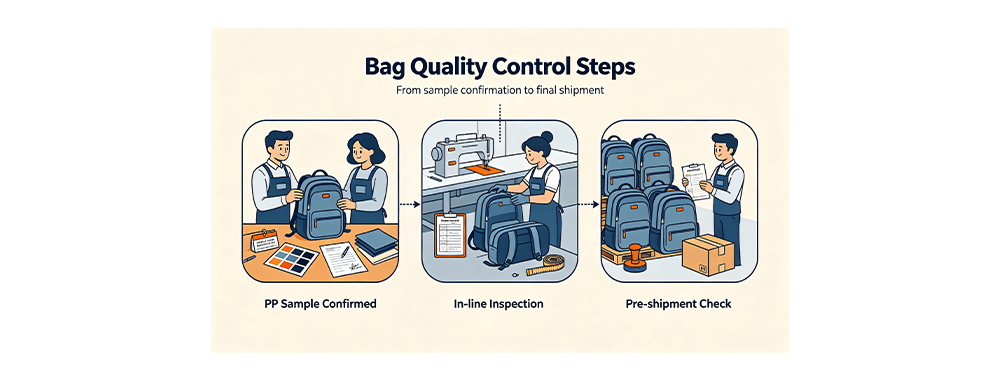
- Pre-production sample approval: Before bulk production begins, always require the factory to provide a Pre-Production Sample (PP Sample) and confirm in writing that the color, materials, craftsmanship details, and other specifications are completely consistent with the original approved sample.
- Written production standards: Issue a detailed specification sheet covering materials, colors, dimensions, stitching density, and acceptable tolerances.
- Online inspection and pre-shipment inspection: Require the supplier to provide an inspection report before shipment, or hire a third-party inspector (SGS, BV, Intertek, or a local inspection agency) to conduct an inspection against the sealed golden sample.
Q8: Can design modifications be made repeatedly during the bag customization process? Is there a limit on the number of revisions?
In theory, revisions can be made, but each round of revisions means additional time and sampling costs. A practical approach is to confirm the overall direction as much as possible through renderings and 3D renderings before the first round of sampling, and then focus modifications during the sampling stage on minor size adjustments, material replacements, and production process optimization.
Some factories have a clear limit on the number of free revisions (for example, 2–3 rounds), after which additional revisions are charged per round. Confirming this rule in advance will help you manage design iterations more carefully.
Q9: How much impact do fabric and hardware choices have on the cost of custom bags?
Materials and hardware are the biggest variables in bag costs.
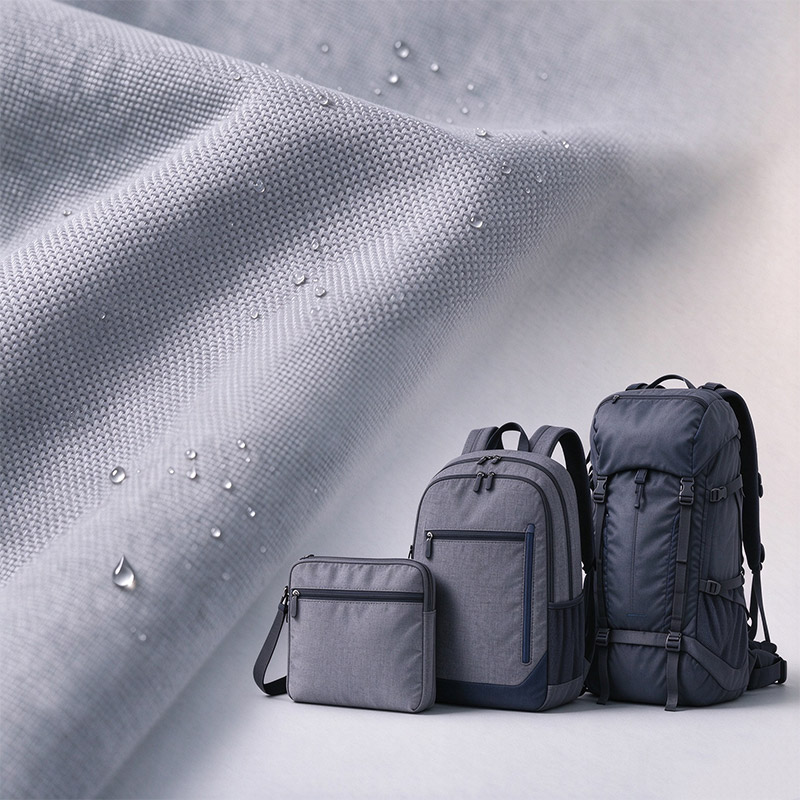
- Fabric: Taking backpacks as an example, the unit price difference between 600D polyester Oxford fabric and 1680D ballistic nylon can be close to 3 times.
In addition, the level of customization directly affects costs: standard in-stock fabrics are usually readily available, with lower unit prices and more flexible MOQs; while custom-dyed fabrics, special finishing processes (such as waterproof or tear-resistant coatings), or exclusively developed recycled eco-friendly fabrics not only have higher unit prices, but may also involve additional risks related to dye-lot variations and minimum dyeing quantities.
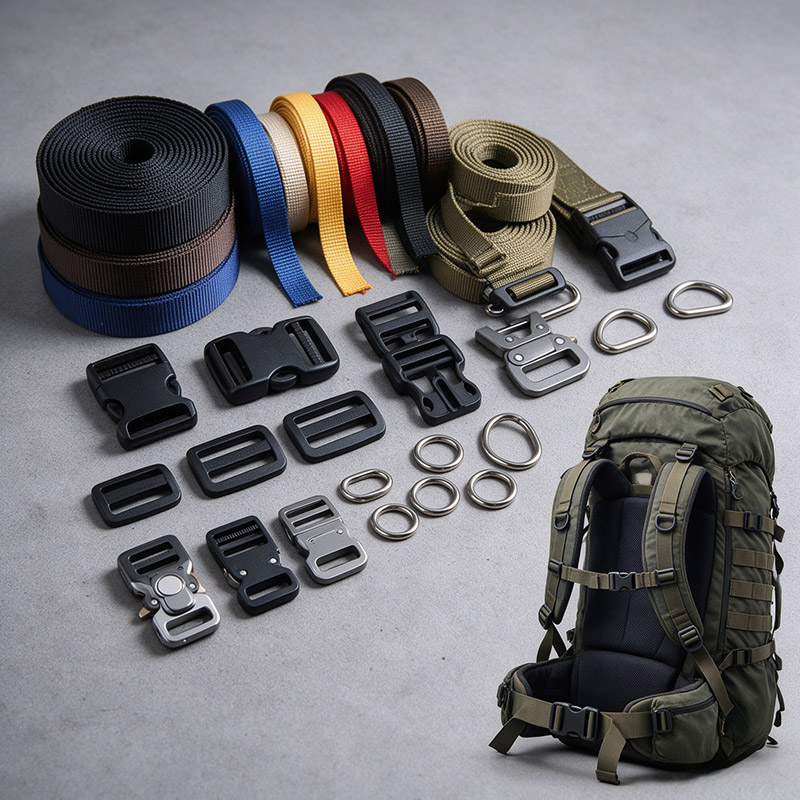
- Hardware follows the same principle. Using standard, off-the-shelf hardware and buckles can significantly reduce costs. Once custom-molded logo plates, uniquely shaped zipper pulls, or special surface treatments (such as PVD coating or a distressed finish) are involved, the per-unit cost can increase significantly in addition to the mold fee.
Q10: What material options are available for B2B bag manufacturing?
The choice of materials in bag manufacturing directly determines the product’s positioning, durability, and suitable applications. Below are some of the most common material categories and their typical applications in B2B customization:
1. Natural Fibers
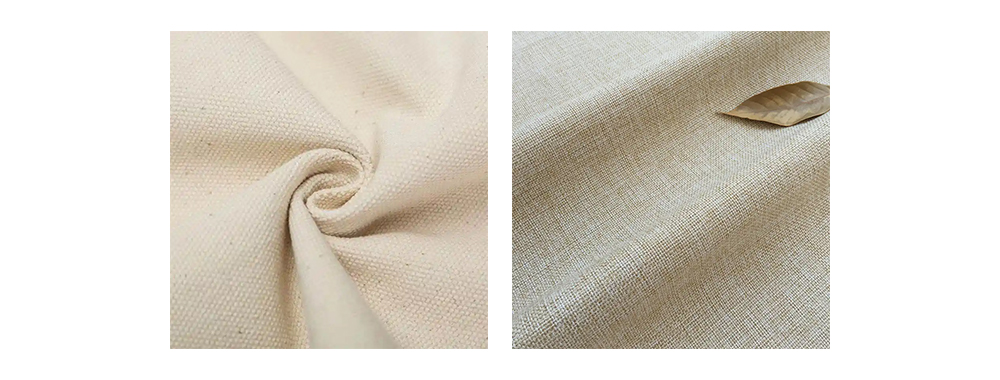
- Canvas: Primarily made from cotton or cotton blends, canvas has a natural texture and good load-bearing capacity. It is suitable for tote bags, shopping bags, and vintage-style backpacks. The typical fabric weight ranges from 8–24 oz, with higher-weight canvas being thicker and more durable.
- Cotton/Linen: Soft to the touch with good breathability, cotton and linen are suitable for environmentally positioned brands or lightweight storage bags. However, their water resistance and abrasion resistance are relatively weaker.
2. Synthetic Fibers
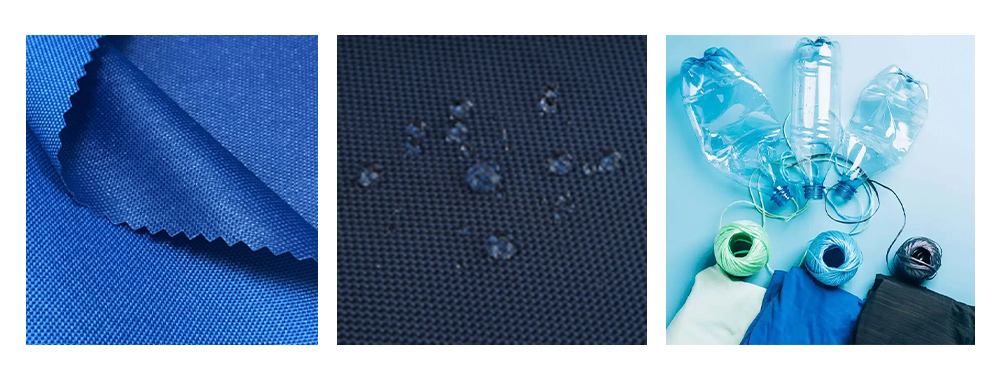
- Polyester: Cost-effective, offers excellent color reproduction, and is easy to maintain, making it one of the most commonly used materials for backpacks and travel bags. Common specifications include 420D, 600D, and 900D. The higher the number, the thicker the yarn and the heavier and more substantial the fabric.
- Nylon: Especially Ballistic Nylon and Cordura®, which offer excellent abrasion resistance and tear resistance, making them a preferred choice for high-end functional backpacks and outdoor bags. Their unit price is generally higher than polyester.
- rPET : Made from recycled plastic bottles, RPET offers an appearance and performance similar to virgin polyester, but with a lower carbon footprint, making it suitable for brands with sustainable sourcing requirements.
3. Leather and Synthetic Leather
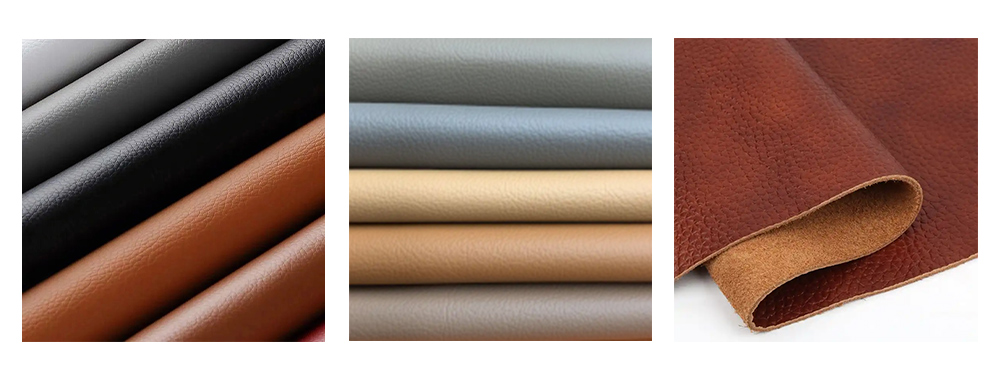
- PU/PVC Leather: Cost-effective, with a wide range of colors and textures, making it suitable for fashion handbags, cosmetic bags, or corporate gifts. PU is softer than PVC and generally offers slightly better environmental performance.
- Genuine Leather: The premium option, developing a unique patina over time with use. It is suitable for high-end business bags and premium cosmetic pouches, but it also comes with the highest costs and maintenance requirements.
- Best Practice: When selecting materials, consider the brand positioning and the final usage environment, rather than focusing solely on the lowest quotation.
Yes, but feasibility needs to be evaluated. Most factories accept customer-specified core materials (such as exclusively developed eco-friendly fabrics or custom zippers), but they may require supplier credentials, minimum order quantities, and proof of delivery stability. If the specified materials affect production efficiency or increase management costs, the factory may charge an additional coordination fee.
Q12: What are the different ways to apply logos and branding, and what are their respective advantages and disadvantages?
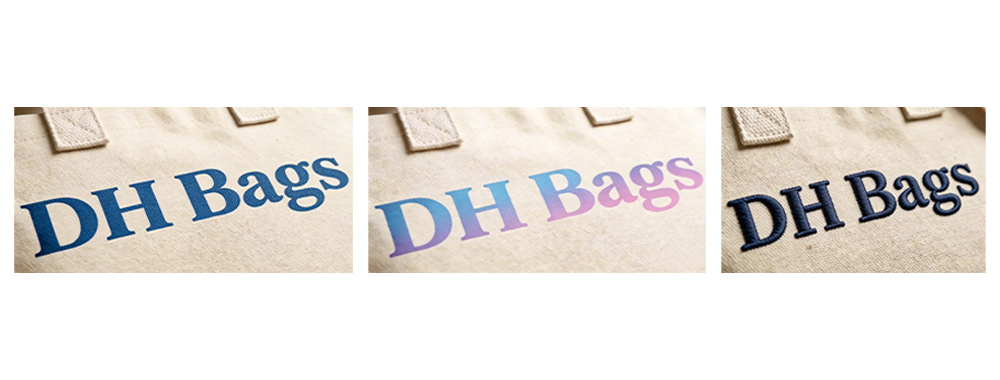
Common logo application methods include:
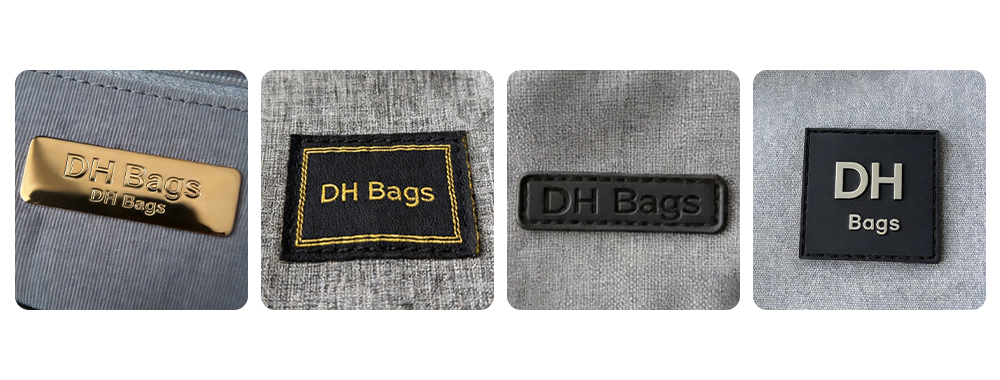
- Screen Printing / Heat Transfer: Low cost and suitable for complex patterns, but with average abrasion resistance.
- Embroidery: Offers a premium look and good durability, but fine, detailed designs in small areas may have limitations.
- Metal Logo Plate / Die Casting: High-end appearance and excellent durability, but mold costs are relatively high.
- Woven Label / Printed Label: Suitable for care labels and main brand labels, with the lowest cost.
- Leather Patch: Fashionable, with a pleasant tactile feel and moderate cost.
- PVC / Rubber Label: Provides a strong three-dimensional effect and vibrant colors, but rubber labels may become harder in low-temperature environments.
The choice of logo application method depends on your brand positioning, budget, and the material characteristics of the bag.
Q13: How long does bulk production for custom bags typically take?
Provided that the sample has been approved and all materials are ready, the bulk production lead time for standard bag styles is approximately 45 days.
However, the production timeline can be affected by various factors, including order quantity, production scheduling during peak and off-peak seasons, fabric procurement lead times, and whether new molds need to be developed. It is recommended to clearly specify the starting point for the “production lead time” in the contract (usually counted from the date the bulk production deposit is received), rather than simply stating “X days after placing the order.”
Q14: How can I avoid bulk production delays during the bag OEM process?
Delivery delays are a common pain point in custom bag manufacturing. To reduce the risk of delays, it is recommended to:
- Confirm material lead times in advance and require the factory to provide a detailed production schedule;
- Clearly specify the delivery deadlines for each stage in the contract;
- Avoid placing orders during major manufacturing shutdown periods in China, such as Chinese New Year and National Day.
In addition, setting aside a 10–15 day buffer period to deal with unexpected situations is a common practice among experienced brands.

Q15: What are the quality inspection standards for bag factories?
Professional bag factories typically use the AQL (Acceptable Quality Limit) sampling inspection standard. Our inspection standards are AQL 1.5 for major defects and AQL 4.0 for minor defects. This means that during batch sampling inspection, a certain proportion of defective products is allowed, but if the defects exceed the specified standard, the entire batch is deemed unacceptable.
In addition to finished-product sampling inspection, our quality control process also includes:
- Incoming Quality Control (IQC): Fabric color variation, fabric weight, and tensile strength testing.
- In-Process Quality Control (IPQC): Stitching density, hardware installation, and structural consistency.
- Final Quality Control (FQC): Appearance, functionality, and load-bearing tests.
Q16: What certifications do bag factories need to have to export to the European and U.S. markets?
Different markets have different certification requirements:
- European and U.S. markets: Common requirements include BSCI (social compliance) or SEDEX, ISO 9001 (quality management), OEKO-TEX (textile safety), etc.
- Environmentally focused brands: GRS (Global Recycled Standard), GOTS (Global Organic Textile Standard), FSC (Forest Stewardship Council) (for packaging), etc.
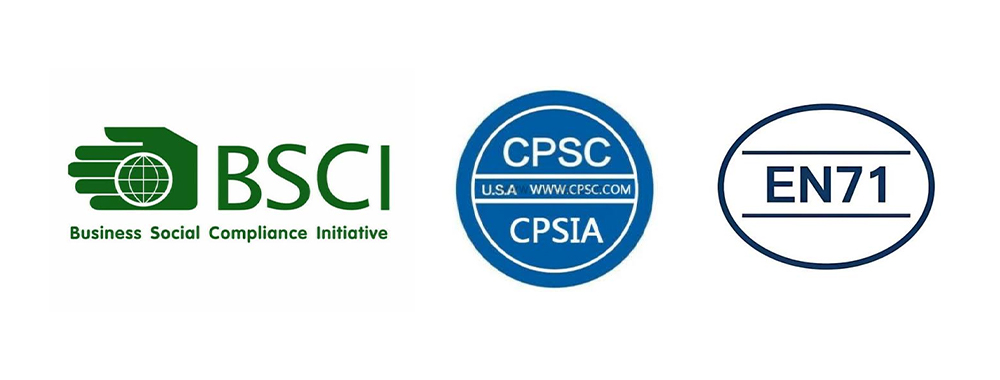
- Children’s products: Safety testing such as CPSIA (U.S.) or EN 71 (EU) may be required.
If you have a clear export plan for your products, you should confirm at the beginning of the partnership whether the factory holds the relevant certifications and whether it can provide the corresponding test reports. A factory lacking the required qualifications may cause customs clearance issues or difficulties in getting approved for e-commerce platforms.
Q17: Can the packaging be customized? What does it include?
Yes. Packaging customization typically includes:
- Inner packaging: Dust bags, branded boxes, moisture-proof bags
- Outer packaging: Printed cartons, shipping marks and labels
- Additional materials: Hangtags, care labels, instruction manuals, stickers
Although packaging accounts for a relatively small proportion of the total cost, it directly affects the consumer’s unboxing experience and perception of the brand. It is recommended to confirm the packaging plan during the sampling stage to avoid delays caused by last-minute adjustments after bulk production has been completed.
Q18: Can bags be shipped in batches after customization is completed? How should warehousing and logistics be arranged?
Most factories support split shipments, but additional warehousing or rescheduling fees may apply. If your sales channels require goods to arrive in separate batches (for example, shipping to different warehouses or accommodating a pre-sale model), you should communicate with the factory about the feasibility of split shipments and any additional costs when placing the order.
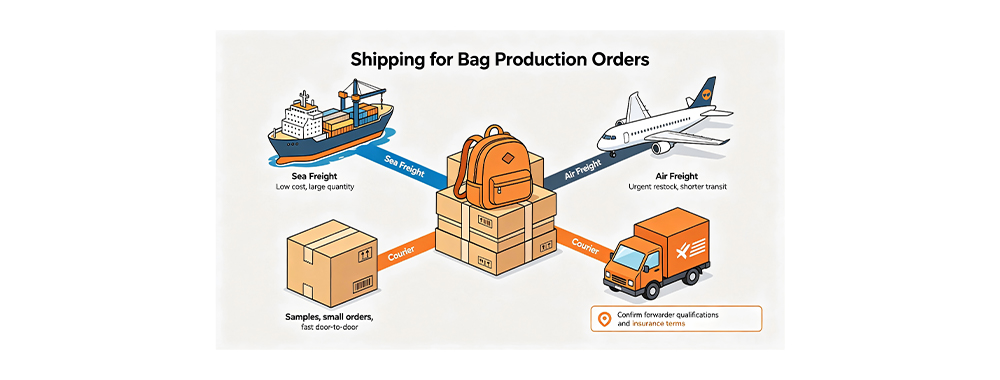
Logistics:
- Sea freight is suitable for large-volume orders with less stringent delivery-time requirements;
- Air freight is suitable for replenishment or urgent orders;
- Express delivery is suitable for small-batch samples or rush orders.
Q19: What should I do if quality issues are found in the bulk production?
First, clearly define the criteria for identifying the issue: Is it a minor appearance defect (such as loose threads or slight color variation), or a functional defect (such as a broken zipper or failure to meet the load-bearing requirements)? Different levels of issues should have different solutions.
It is recommended to specify the following in the contract:
- The valid period for raising quality objections within X days after receiving the goods
- The process for returning or replacing defective products, or handling them through a price reduction
- The compensation limit and allocation of responsibility in the event of a major quality incident
For high-value orders, consider appointing a third-party inspection company to conduct an independent inspection before shipment, which can significantly reduce the risk of disputes after receiving the goods.
Q20: How can I establish a long-term and stable relationship with a factory?
The core of a long-term partnership is transparency and aligned expectations:
- Regularly share your sales data and market feedback to help the factory optimize production scheduling and inventory preparation
- Place appropriate baseline orders during the off-season to maintain the factory’s willingness to allocate production capacity to your brand
- Respect the factory’s production schedule and avoid frequent rush orders or last-minute design changes
- Establish an annual cooperation framework and use stable order volumes to secure better pricing and priority in production lead times
A good supplier relationship is not simply a buyer-seller relationship, but a partnership. When you view the factory as part of your brand’s growth rather than merely an executor, both sides can gain greater value from long-term cooperation.
Conclusion
Bag OEM is a complex, systematic process involving design, materials, craftsmanship, production, and logistics. The 20 questions most frequently asked by brands essentially revolve around one core issue: How can you turn a good product idea into a stable, shelf-ready product while controlling costs and risks?
We hope this FAQ provides you with a clear decision-making framework. If you encounter more specific questions in a particular project—such as sourcing special fabrics, obtaining environmental certifications, or optimizing cross-border logistics—feel free to reach out to our team at any time. Regardless of whether you ultimately choose to work with us, we are happy to share the industry experience we have accumulated over the years.