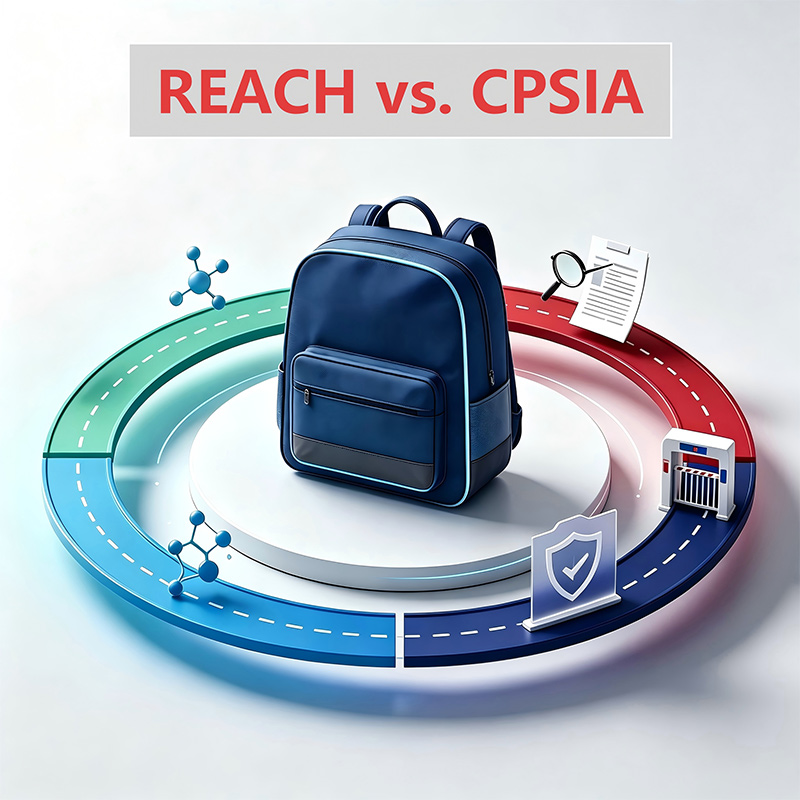
For bags exported to European and U.S. markets, chemical compliance is an unavoidable prerequisite. REACH and CPSIA are two independently operated regulatory systems, but in the bag industry, their controlled substances significantly overlap — key substances such as phthalates, heavy metals, and azo dyes appear on the testing lists of both regulations.
However, their underlying principles are fundamentally different. REACH follows the principle of “preventive and comprehensive chemical control”, applying to all consumer products entering the European market. Through continuously updated substance lists (Annex XVII and SVHC), it imposes dynamic restrictions across the entire supply chain. CPSIA, on the other hand, is centered around “children’s safety standards”, focusing on products intended for children aged 12 and under, and emphasizing mandatory third-party testing and traceable compliance documentation.
For buyers and sourcing teams, confusing the applicable scope, testing logic, and documentation requirements of these two systems is a common cause of delayed shipments, customs detention, and even product recalls. This article provides a systematic breakdown of REACH and CPSIA in terms of their regulatory scope, testing logic, and implementation differences in the bag industry, offering a practical compliance decision-making reference for exporters and buyers.
1. What is “REACH”?

REACH (Registration, Evaluation, Authorisation and Restriction of Chemicals) is not a certificate, but a dynamically updated chemical control system. If products entering the EU market are compared to a person, REACH requires you to prove that every chemical substance contained in what you wear, use, or come into contact with has an “identity, traceability, and controlled risk level.”
The core purpose of this regulation is not simply “pass the test and obtain approval”, but to establish a chemical information chain covering the entire supply chain. For bags, this means that materials such as fabrics, coatings, hardware accessories, adhesives, and even hangtag inks must each be separately identified and assessed.
1.1 Two Lists, Two Types of Restrictions
The most practical way for bag manufacturers to understand REACH is to break it down into two “lists”:
Annex XVII (Restriction List)
This is the clear “prohibited line.”
Substances such as azo dyes (AZO dyes), certain phthalates, and short-chain chlorinated paraffins (SCCPs) are restricted substances. Once detected in products beyond permitted limits, they constitute non-compliance.
The regulation does not distinguish between product categories and does not provide exemptions simply because the content is “very low.”
SVHC (Substances of Very High Concern) List
This is the dynamic “watch list.”
As of 2026, the European Chemicals Agency (ECHA) has expanded this list to more than 240 substances. Unlike Annex XVII, SVHC substances are not automatically prohibited. Instead, they are subject to disclosure requirements when their concentration exceeds the threshold of 0.1% by weight in articles.
When an SVHC substance exceeds this threshold in a product, manufacturers must promptly inform brand owners, who then assess whether material replacement is necessary.
Key Difference:
Annex XVII asks:
“Can this substance be used?”
SVHC asks:
“Does this substance need to be disclosed?”
Both systems operate simultaneously and neither can be ignored.
1.2 Why REACH is Called a “Dynamic Regulation”
The unique feature of REACH is that it is never “frozen.” The SVHC list is updated every six months. In February 2026, n-hexane was added to the list, directly affecting production lines using low-cost solvent-based adhesives for bag lining applications.
A formulation that was compliant last year may require reassessment this year.
This dynamic nature means REACH compliance is not something that can be solved through a one-time test report. Instead, it requires continuous monitoring of regulatory updates and regular reviews of material formulations as part of long-term compliance management.
2. What is “CPSIA”?

The underlying logic of CPSIA (Consumer Product Safety Improvement Act) is completely different from REACH. It does not apply to all consumer products; instead, it focuses specifically on “children’s products intended for children aged 12 and under.”
2.1 When Will Bags Be Subject to CPSIA?
CPSIA does not automatically apply to every bag exported to the United States. Its applicability depends on the intended user group of the product:
Clearly adult bags
(such as business commuter bags and laptop sleeves):
CPSIA is generally not mandatory.
Clearly children’s bags
(such as products labeled “school backpacks” or “children’s travel bags”):
CPSIA compliance is mandatory, requiring third-party testing and a CPC certificate.
Products with ambiguous positioning
(such as small-sized bags, cartoon-colored designs, or animal-shaped bags):
Even without explicit labeling for children, the CPSC may classify them as children’s products based on “reasonably foreseeable use.”
This means the same bag may move from “not subject to CPSIA” to “CPSIA mandatory” simply because the color changes from navy blue to bright yellow, or the size is reduced from 15 inches to 10 inches.
2.2 The Core Mechanism of CPSIA: Numerical Limits + Mandatory Certification
Unlike REACH’s “substance lists + disclosure” approach, CPSIA establishes explicit numerical limits for key hazardous substances and requires testing by a CPSC-recognized third-party laboratory.
| Substance | Limit (Children’s Products) | Key Characteristics |
| Lead (Surface Coatings) | ≤90 ppm | Strict numerical limit with no flexibility |
| Lead (Substrate Materials) | ≤100 ppm | Applies to all substrate materials, including metals, plastics, leather, etc. |
| Phthalates | Eight restricted phthalates (DEHP, DBP, BBP, DINP, DIBP, DPENP, DHEXP, DCHP), each limited to ≤0.1% (1000 ppm) | Applicable only to children’s products; no mandatory requirement for adult products |
After successfully passing CPSIA testing, the importer or brand owner must issue a CPC (Children’s Product Certificate) declaring that the product complies with all applicable regulations.
This certificate is not a factory self-declaration, but a legally required document based on testing conducted by a CPSC-recognized third-party laboratory.
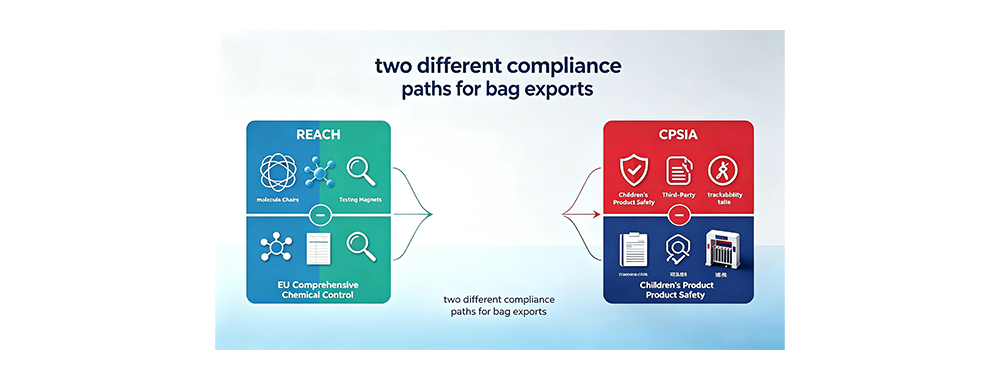
3. Key Differences Between the Two Systems
After understanding what REACH and CPSIA are individually, the more important question is: How are they different?
These differences directly determine the compliance strategies that manufacturers and buyers need to adopt.
| Comparison | EU REACH | U.S. CPSIA |
| Scope of Application | All consumer products entering the EU market, regardless of user age | Primarily children’s products intended for children aged 12 and under |
| Regulatory Philosophy | Preventive and comprehensive chemical control with continuously expanding substance lists | Baseline safety requirements focusing on known high-risk substances |
| Testing Method | Material-based testing (fabric, hardware, adhesives, etc. tested separately) | Product-based testing, with certification required for each children’s product SKU |
| Compliance Documents | Test reports + Declaration of Conformity (DoC) | CPC (Children’s Product Certificate) + Traceability Label |
| Laboratory Requirements | ISO/IEC 17025 accredited laboratories | Must be a CPSC-recognized third-party laboratory |
| Update Frequency | SVHC updated every six months; Annex XVII revised periodically | Substance list remains relatively stable, while enforcement procedures continue to tighten |
One common misconception is that because both REACH and CPSIA regulate lead and phthalates, passing REACH automatically means passing CPSIA.
This is incorrect.
REACH regulates lead through different provisions and does not establish explicit ppm limits in the same way as CPSIA. Furthermore, the laboratory recognition system required under CPSIA is entirely different from that of REACH. A REACH test report cannot replace a CPC certificate.
4. Bag Compliance Trends in 2026
The compliance landscape is constantly evolving. In 2026, both REACH and CPSIA introduced significant developments in terms of substance restrictions and regulatory enforcement procedures, directly impacting the cost and operational processes of exporting bags.
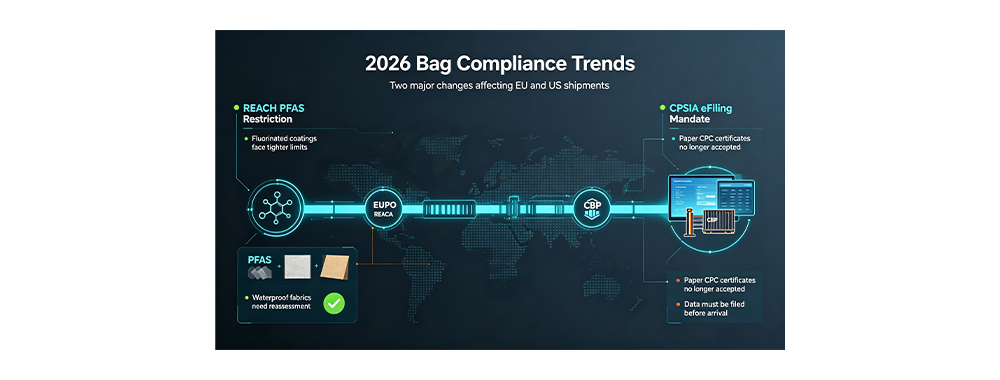
4.1 REACH: PFAS Restrictions Officially Take Effect
PFAS (Per- and Polyfluoroalkyl Substances) are widely used in waterproof coatings and leather tanning due to their excellent water- and oil-repellent properties. In recent years, however, they have received increasing attention from the European Union because of their environmental persistence and potential health risks.
According to the REACH regulatory roadmap, PFAS-related restrictions will be formally incorporated into the REACH Restriction List starting in 2026, imposing extremely stringent concentration limits on the use of most PFAS substances. Materials containing non-compliant PFAS will no longer be allowed to enter the EU market.
Many commonly used “three-proof” fabrics (waterproof, oil-resistant, and stain-resistant) rely on fluorinated chemical treatments. Following the implementation of PFHxA restrictions, the compliance threshold for these materials has increased substantially.
As a result, bags previously using conventional PFAS-based waterproof coatings must adopt new material formulations and undergo fresh compliance evaluations. Supply chains serving the EU market will need to complete a comprehensive material transition.
4.2 CPSIA: Electronic Filing Ends the Era of Paper-Based Customs Clearance
Beginning July 8, 2026, U.S. Customs and Border Protection (CBP) requires all consumer products regulated by the CPSC to be electronically filed through the ACE (Automated Commercial Environment) system (eFiling).
This means:
- Paper CPC certificates will no longer be accepted at U.S. ports.
- Compliance data for every shipment must be uploaded into the system before the goods arrive.
- Any mismatch in submitted data may trigger automatic customs detention, which can no longer be resolved simply by submitting supplementary documents onsite.
- For bag exporters relying on the U.S. market, this change shifts the compliance milestone from “after arrival” to “before shipment.” Suppliers must complete all testing before loading and provide traceable laboratory report numbers before the goods are shipped.
5. Practical Experience Sharing: Four Major Chemical Risk Areas in Bags
When translating regulatory requirements into actual products, the chemical risks associated with bags can generally be categorized into four key areas. Understanding these areas helps manufacturers and buyers establish a “compliance-first” mindset during the product design and sourcing stages.
| Risk Area | Typical Materials | Key Testing Items | Applicable Regulations |
| Surface Materials & Coatings | PU leather, PVC, waterproof coatings | Phthalates, SCCPs, PFHxA (newly added in 2026) | REACH Annex XVII + CPSIA |
| Metal Hardware | Zippers, D-rings, magnetic snaps | Total lead, total cadmium, nickel release | REACH Annex XVII + CPSIA |
| Linings & Adhesives | Lining fabrics, foam, adhesives | n-Hexane (new SVHC in 2026), azo dyes, DMFa | REACH SVHC + Annex XVII |
| Structural Fillings | EVA/PE shoulder pads, bottom boards | Organotin compounds, formaldehyde | REACH Annex XVII |
6. FAQ
Q1: Is CPSIA testing mandatory for adult bags exported to the United States?
A: Not necessarily. If the product is clearly intended for adults and does not imply children’s use, CPSIA is generally not mandatory. However, it is recommended that the product at least meets baseline requirements for lead and phthalates to avoid customs disputes or additional inspections required by e-commerce platforms.
Q2: How long is a REACH test report valid?
A: There is no legally defined validity period. However, the industry practice is generally six months. Since the SVHC list is updated every six months, an outdated report may no longer cover the latest restricted substances. In addition, if the material formulation or supplier changes, the original report automatically becomes invalid.
Q3: Do metal zippers on bags need to be tested separately under REACH?
A: Yes. REACH requires testing based on individual material components. Metal zippers are considered an independent risk area and should be tested separately for total lead, total cadmium, and nickel release (if prolonged skin contact is expected). Testing the entire bag as a single sample cannot satisfy the requirements of EU RAPEX inspections.
Q4: Can the factory issue the CPC certificate required under CPSIA?
A: Yes, but the certificate issuer (Certifier) must be the U.S. importer or brand owner, who assumes the legal responsibility. In addition, the testing must be completed by a CPSC-recognized third-party laboratory. The factory may assist in preparing the required test data, but the legal responsibility rests with the U.S. importer.
Q5: If the fabric has OEKO-TEX® STANDARD 100 certification, does that mean it is REACH compliant?
A: No, although there is substantial overlap. OEKO-TEX® STANDARD 100 primarily focuses on the safety of textile materials that come into contact with the skin and covers many of the restricted substances included in REACH. However, it does not cover all SVHC substances and does not apply to non-textile components such as hardware and adhesives. The best practice is to use OEKO-TEX® certified fabrics together with supplementary testing for hardware and coatings.
Q6: What operational changes does CPSIA eFiling bring to exporters after July 8, 2026?
A: Exporters must ensure that CPC data has been electronically submitted through CBP’s ACE system before the goods arrive in the United States. This means complete information—including laboratory report numbers, the CPSC-recognized laboratory identification number, product SKUs, and other compliance data—must be obtained from suppliers in advance and coordinated with customs brokers for PGA message submission. Paper certificates will no longer serve as the basis for customs clearance.
Q7: What testing items are required for EVA shoulder pads used in bags?
A: EVA foam materials should primarily be tested for organotin compounds (catalyst residues) and formamide (foaming agent residues). Beginning in 2026, manufacturers should also monitor whether any newly added SVHC substances are applicable. If recycled EVA is used, additional screening for polycyclic aromatic hydrocarbons (PAHs) is recommended.
Q8: Do recycled materials (such as rPET) present higher REACH compliance risks?
A: Yes. Recycled materials often contain “legacy chemicals.” Flame retardants, plasticizers, and other chemicals present in previously used plastics cannot always be completely removed during the recycling and pelletizing process. The initial REACH testing failure rate for recycled fabrics is generally about 15% higher than that of virgin materials, making stricter upstream supply chain audits necessary.
Conclusion
The compliance landscape in 2026 is more dynamic than ever before. PFAS restrictions are becoming more stringent, the SVHC list continues to expand, and electronic filing has become mandatory for U.S. imports.
For bag manufacturers and buyers, moving compliance from the testing stage before shipment to the material selection stage during product design is the most effective way to control costs, protect delivery schedules, and maintain brand reputation.
Further Reading:
PFAS Ban Is Coming — But Why Did the U.S. Only Delay Its Implementation Timeline (Expected in 2026)?
PPWR Compliance Guide